

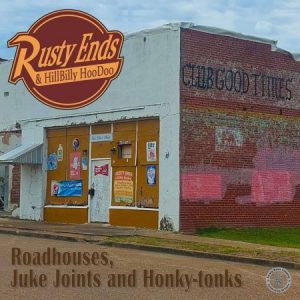
 Rusty Ends and Hillbilly Hoodoo – Roadhouses, Juke Joints and Honky Tonks
15 Tracks – 50 minutes
Louisville, Kentucky’s Rusty Ends is a long-time member of the Kentuckiana Blues Society and a regular columnist the Society’s monthly newsletter. While he writes many columns about performers who influenced him or performances by artists he saw over the years that were impressive, he also frequently regales the readers with his exploits and adventures in the venues he cites in the title of this album. The liner notes call Rusty’s Hillbilly Blues “a beguiling blend of the contrasting idioms that the guitarists soaked up like a sponge during a well-spent Kentucky youth. It’s a combination of our Kentucky roots and the hoodoo beat of New Orleans and the greasy kind of swamp stuff.” Rusty further notes “To this day, I get uncomfortable when people don’t dance. I just feel that I am doing something wrong if I can’t get them up on the dance floor.”
The band featuring Rusty on guitar and vocals, Dave Zirnheld on bass, and Gene Wickliffe on drums came together for a 1996 release then titled “Rusty Ends Blues Band”. That story continued to 2020 when Rusty consulted with Michael Frank, the Earwig Records CEO. After talking with Rusty and listening to that older recording, Michael agreed to re-release that album on Earwig. That also led to a new recording, now noting the band as the Hillbilly Hoodoo, called “The Last of The Boogiemen” released in 2022. The 2020 re-release and the trifold cd release of the new album both feature Bill Dahl’s detailed historic information about Rusty and the band. I will not re-hash or plagiarize Bill’s fine work. Buy the cd’s to gain that background. You will not get that if you stream the album.
The album consists of fifteen songs including three covers. Guests for the album include Chicago keyboard great Roosevelt Purefoy playing piano and organ on nine tracks and Louisville’s Wayne Young co-writing tracks 1,4,6, and 13, and playing 2nd guitar on tracks 1,2,3, and 9.
The album opens with “Bad Like Billy the Kid” as Rusty cites “I may be old, but I’m never going to stop”. “But when I strap on my guitar…when I turn it up…I’m bad like Billy the Kid”. “The Same Thing” kicks up the energy as he states “Roadhouse, juke joint, honky tonk, what’s in a name”. Country, blues, even rock & roll, western swing, zydeco, old school soul. Choose your poison, they’ll all make you move, ’cause each one’s got its own low down greasy groove.” A cover of Lonnie Mack’s 1988 “Honky Tonk Man” noting “I have my fun” is next with Roosevelt’s piano getting things jumping. Rusty declares he is “Lost in the Blues” as “Once I was on the road to money and success, that ain’t the way to happiness. Now I’m searching for love and affection, I must have gone in the wrong direction.” Roosevelt plays organ as Rusty builds the song as an old-time soul song.
“Rockabilly Train” gets the music rolling with the “Guitar man at the throttle, bass man shoveling coal, drummer pounding the backbeat makes the train go.” Rusty kicks back to an old school stroll as he lists a long list of things from lost loves to those lost in drugs, prophets preaching hate, and lying politicians all which cause “Angels Sing the Blues”. Dave steps forward for vocals on a cover of Koko Taylor’s 1969 “(I’m) A Little Mixed Up” written by Willie Dixon citing “what I know is I’m still alive”. Next Rusty declares “You told me I was nothing without you. I used to believe that was true” but now “The Worm’s Turned”. Rusty’s guitar cries as he laments “I wake up after midnight, tears falling down in streams. I call out for help, but there is no one to hear my “Midnight Screams”.
Ray Sharpe’s 1959 Texas country blues “Linda Lu” gets a honky-tonk feel with Roosevelt’s piano and Rusty’s stinging guitar. “Lie To Me” is an emotional appeal to his woman as he tells her “Tell me a lie, you know how. You never told the truth before, why start now?” “Tell me you love me.” Dave steps back up to the mike on “Thing Called Love” as he declares “You thought it’d last forever, but nothing lasts that long. It will drive you to drink because it hurts to be sober. You were glad when it started, but relieved when it’s over.” Rusty identifies that “When A Geezer Plays the Blues” people say “look at that old man, what’s he doing up there. He hears them joking, laughing at the bar. But he just grins and straps on the his guitar”. “it’s his love. It’s his truth…As the music drags them to the floor”. “Bourbon Moon” is an instrumental tribute to Santo and Johnny’s 1959 hit “Sleepwalk”. The album closes with a cover of Willie Nelson’s “Night Life”, originally recorded by Ray Charles in 1966.
Rusty loves to challenge listeners with his crossover of genres, stating the blues “Comes from someplace really deep. I think it’s an African American art form, it comes from maybe deep inside the earth or something. Maybe something really primal. To me, blues is what makes you feel inside”. Rusty mixes deep emotions and a musical history through soul, blues, rock, and a touch of country creating his own pure sound and bringing his sincere love of the music to the listener.
