|

Cover photo © 2025 Peter Hurley
In This Issue
Bucky O’Hare has our feature interview with Dave Specter. We have seven Blues reviews for you this week including new music from Candice Ivory, Vanja Sky, Rory Block, The Blues Masters Featuring Cassie Taylor, Micke & Lefty featuring Chef, Debbie Bond and Dyer Davis. Scroll down and check it out!
From The Editor’s Desk
Hey Blue Fans,
Our good friends at the Crossroads Blues Society are throwing a Blues Party this week with their 16th Annual Crossroads Blues Festival in Rockford, IL Saturday August 23, 2025!
The fest starts a noon with The Stephen Hull Experience and is followed by Nora Jean Wallace, Brandon Santini and headliner Chris Cain. They have great food and beverages for this cool festival right on the river.
Advance tickets and info is at https://www.crossroadsbluessociety.com/
Blues Blast Magazine will be there so be sure to say hello!
Wishing you health, happiness and lots of Blues music!
Bob Kieser


Featured Blues Review – 1 of 7
|
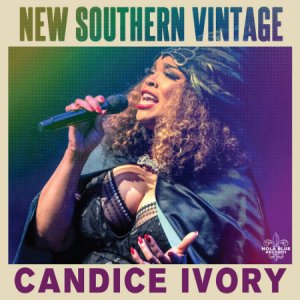 Candice Ivory – New Southern Vintage Candice Ivory – New Southern Vintage
Nola Blue Records
https://candiceivory.com
14 Tracks – 51 minutes
In 2023, Candice Ivory released her tribute album, When The Levee Breaks: The Music of Memphis Minnie to much acclaim. With this record she explores the “iconic folk form as well as the heroines and heroes who created it”. Her liner notes further provides insight into her direction, “Today blues is a global music, known by and cherished by people all over the world. But its roots are in the American South – in places like Memphis and Mississippi, where I first heard the blues, and in nearby outposts like St. Louis where I live now”. She again cites Memphis Minnie as one of her greatest inspirations, and also includes her great uncle Will Roy Sanders who fronted the Memphis band The Fieldstones in the 1970s’ and 1980’s.
For this album, Candice is joined by her tour band, The Blue Bloods for the first eight songs. The Blue Bloods include Robert Allen Parker on guitar, Adam Hill on guitar, Khari Wynn on bass and Donald R. Johnson on drums. Ben Levin also guests on piano on most tracks. She brings in several guests on individual songs including Jimmy “Duck” Holmes, the caretaker of the Bentonia, Mississippi School of Blues Guitar. While New Southern Vintage blues looks back to the past, the “New” references that it also fits into the future. Thus, she brings in new young artists like Ben as well as international artists who are from around the globe but into the Southern sounds. Khari Wynn who is part of her band is a young bass player who plays with Public Enemy. She states in her liner notes “that no matter how far we travel down the blues highway, we can always go back home to the land where the blues began”.
Jan Hartmann guests on harmonica on the opening track “Ain’t So Blind” as she identifies “Now you’re busy all the time, the devil on your mind, with the gal you’re out of line…you think I can’t see all the signs”. She then tells “All my children, you got “Blue Blood” in your veins.” “You’ve been gifted from the start of day”, all with a hill country vibe. Candice then covers “I’m In Trouble”, a song that her great uncle sang. The song gets things rocking with Ben’s honky-tonk piano, Adam’s guitar and Jan’s harmonica shining as Candice announces “I’m in trouble way over my head”.
“Foolish Pleasure” features another young performer, Chris Stephenson on Wurlitzer organ. Chris has played with Mick Kolassa and Victor Wainwright among others. Kenyan vocalist Yubu Kazungu adds her voice to Candice’s as they state, “Come on in my kitchen, raise the heat up high”. Ben turns up the heat on a rollicking piano and Candice gets things jumping as she declares, “I am “Looking for My Baby”. “You can run but you cannot hide.” Her uncle sang the song “Black Mattie” as have many other blues musicians, but I can assume that the self-penned “Strong Black Mattie” might be referenced back to her uncle as well. The song is a shift from the well-known song telling another story noting Mattie is available “if you need a good woman” but asks “Can’t a girl have some fun?”
Antonio Vergara from Ecuador is a well-known guitarist throughout South America and the Caribbean. On “Let Your Love Shine”, Antonio plays lap steel, electric guitar and Wah Wah. The song is a smooth love song with Candice pleading “when the darkness has pain and misery, you light your candle just so I can see”. She then declares “I’ve got my eyes on you baby, but I have got to “Look Away” for a while”. ” I see every step you take…but I am one step ahead”. “Catfish Blues” brings together the young and the older artists with Jimmy “Duck ” Holmes taking the lead vocals and playing guitar with Candice providing back-up with Ben again on piano and young Memphis harmonica player Damian “Yella P” Pearson joining in. The song is a cover, here attributed to Robert Petway who did first record the song in 1941 but is generally shown as a traditional song. Jimmy delivers a pure, old-school blues version of the song.
Memphis guitarist David Evans is a music historian who teaches Ethnomusicology at the University of Memphis since 1978. He has been inducted into the Blues Hall of Fame as a non-musician. He joins Candice for a cover of “Corrina”, a song that has had many variations in both the blues and folk genres with changes in lyrics and even in theme. This version is credited to Clyde Maxwell. She notes “that fool got drownded down in the Red Sea”. Candice again joins the young with the international on “Crown Royal Bag Blues” with Ben and Yella P joined by Japanese guitarist Takuto Asano.
Candice closes with covers of two Memphis Minnie songs, “World of Trouble” from 1953 and “Shout the Boogie” from 1947. David Evans and Ben play on both songs and fellow musicologist Andy Cohen joins on guitar with David on the latter song. The first song establishes a life of strife that left her “with no place to go”. The latter song in keeping with its title certainly gets the boogie going.
Candice concludes her liner notes with “For me, New Southern Vintage is not just music – it’s a way of life, and I gratefully acknowledge all my fans who allow me to share this music-life with them”. The album drives home the universality of the music with the various international artists she brings to the album, the young performers who are adding their music to the genre and the older blues stars still alive and pursuing their own love of the music. And of course, Candice must be recognized for her glorious vocals and the great mixtures of originals and selected covers she brings to show that time does not alter the music and blends well in a new modern showcase.
Writer John Sacksteder is a retired civil engineer in Louisville, Kentucky who has a lifelong love of music, particularly the blues. He is currently the Editor of the Kentuckiana Blues Society’s monthly newsletter.
|


Featured Blues Review – 2 of 7
|
 Vanja Sky – Access All Areas – Live Vanja Sky – Access All Areas – Live
Broken Silence – 2025
www.vanjasky.rocks
CD1: 8 tracks; 37 minutes
CD2: 8 tracks; 47 minutes
Croatian Vanja Sky’s first break was on the Ruf Blues Caravan in 2018 where she played with Bernard Allison and Mike Zito. Vanja plays a lot in Europe, particularly Germany, where this double CD was recorded, in Berlin in January 2024. Vanja handles lead vocals (all in English with just a trace of accent) and guitar, lead guitar is in the hands of Guenter Hass, the rhythm section is bassist Artjom Feldster and drummer Johannes Hoffman. The material comes from across her previous albums, Vanja writing most of the songs here, assisted by a number of others, including Guenter and Artjom on two songs. There are also six covers which perhaps reveal something about Vanja’s influences, notably two from Rory Gallagher and one from Alvin Lee.
An opening salvo of “Rock n’Rolla Train” and Rory’s “Bad Penny” (also the title of Vanja’s 2018 debut album) sets out the band’s stock in trade of solid riffs, followed by two songs with similar themes, “Devil Woman” and “Voodoo Mama”, the latter complete with devilish laughter from Vanja. She then takes the pace off and dons her acoustic guitar for “Run Away”, a song taken from her last album Reborn. Initially solo, Guenter adds some ethereal slide before the band joins in at the half way point and the tune develops attractively with Guenter’s bright lead work. The gentler pace continues with “Troublemaker”, Artjom’s languid bass heavily featured here. Going back to her debut album, “Hard Working Woman” returns to the heavy riffing style and chugs along well, Vanja stretching her vocals on this one and the band adding backing vocals. The first CD ends with a cover of The Bee Gees’ “To Love Somebody”, a song that has been covered extensively over the years, not least by the great Nina Simone; Vanja plays it pretty straight and encourages the crowd to sing along with the familiar tune.
CD2 is equal parts originals and covers, an exhilarating run through Sam and Dave’s “I Take What I Want” punctuating a run of four originals which start with a short “Can You Hear Life Knocking”. “Hit Me With The Blues” is an eight minute slower tune with plenty of guitar and is followed by a moody “Hero”. The centrepiece of the CD is a ten minute “Crossroads Of Life” which opens with the two guitars creating a wall of sound from which the tune emerges, another slower tune with emphatic vocals, more guitar heroics from Guenter either side of a quiet, introspective middle section and a few classic rock quotes too! The album closes with three covers. Alvin Lee (Ten Years After) is the source for “I’d Love To Change The World” which ebbs and flows, the second Rory Gallagher tune is a thrilling eight minutes of “Shadow Play” that was this reviewer’s pick of the whole album and the encore is a barnstorming run through one of the great garage rock tunes, “Louie Louie” (Richard Berry).
The album is beautifully packaged in a three part gatefold with the two CDs and a space for the sleeve notes, a detailed list of dates for 2025 and even a mock backstage pass too! Anyone who enjoys female led blues-rock is sure to like this set.
Blues Blast Magazine Senior writer John Mitchell is a blues enthusiast based in the UK who enjoys a wide variety of blues and roots music, especially anything in the ‘soul/blues’ category. Favorites include contemporary artists such as Curtis Salgado, Tad Robinson, Albert Castiglia and Doug Deming and classic artists including Bobby Bland, Howling Wolf and the three ‘Kings’.
|


Featured Blues Review – 3 of 7
|
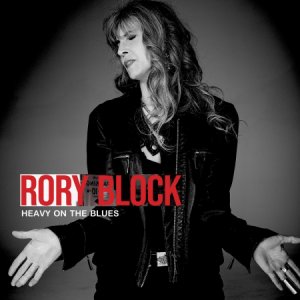 Rory Block – Heavy on the Blues Rory Block – Heavy on the Blues
M.C. Records
http://www.roryblock.com
10 tracks – 41 Minutes
Rory recorded her first album at age 12 backing her father on The Elektra String Project. Her father ran a sandal shop in Greenwich village in the 1960’s amid the booming Greenwich Village folk music scene. Folk artists like Maria Muldaur and John Sebastian influenced her desire to learn classical guitar. At age 14, she met Stefan Grossman, who introduced her to the music of the Mississippi Delta blues artists.
Subsequently she studied the styles of the original guitar masters first by listening and carefully trying to emulate the sounds she heard. At age 15, she left home to sit at the feet of the blues giants that were still alive so she could further hone her craft. Her mentors included Mississippi John Hurt, Reverend Gary Davis and Son House. She moved to Berkley California where she continued to play in clubs and coffeehouses. The result of her work is the release of thirty-five previous albums, and this her 36th album demonstrating her mastery of the roots music.
Her albums maintain the traditional country and Delta sounds resulting in seven Blues Music Awards. In the early 60’s, she released an album called How To Play Blues Guitar. She continued to release albums mixing her original songs with covers of songs from those who had influenced her. Starting in 2006, she released the album The Lady and Mr. Johnson, which was dedicated to Robert Johnson. A series of tribute albums followed covering the music and styles of Son House, Mississippi Fred McDowell, Rev. Gary Davis, Mississippi John Hurt, Skip James, Bukka White and concluding with the 2018 album dedicated to Bessie Smith. And in 2022, featured a tribute to Bob Dylan on Positively Fourth Street.
This album features nine covers and one original song all clearly demonstrating her slide guitar and comfortable voice. Rory plays acoustic and slide guitars, bass and drum programming along with all vocals and brings along a few guest performers along the way. She opens with her acoustic guitar on Tommy Tucker’s whimsical 1964 “High Heel Sneakers”. Next she drops a six minute version of Little Milton’s 1972 “Walking The Back Streets” with Ronnie Earl joining her on electric guitar. She sings, “It makes me so sad to hear my baby say goodbye…that’s why I walk the back streets and cry”. Jimmy Vivino joins on guitar on Buddy Guy’s 2001 “What Kind of Woman Is This”. Rory said she changed some of Buddy’s male dominated lyrics to be more appropriate for her. noting “you should be here by my side, I could use a man just like you. We could do everything Adam and Eve would do”.
She shifts into a gospel mode for the traditional “Hold To His Hand” recorded as an a cappella song. Joanna Connor is her next guitar guest on Jimi Hendrix’s 1967 “The Wind Cries Mary” with some fine slide guitar remaking the song to fit her style. She then makes a jump back in time to Charley Patton’s country blues 1929 “Down The Dirt Road Blues” which sounds like something Bob Dylan would have recorded.
She stays in the Delta Blues for Willie Brown’s “Mississippi Blues”. as she declares she is “goin’ back to the Delta where I can have my fun, where I can drink my white lightnin’ and gamble. and noting “don’t the delta look lovely when that evening sun goes down”. Memphis Minnie’s 1941 “Me and My Chauffeur” continues the country blues with the tale of the man who “drives so easy I can’t turn him down”.
Her original song “Can’t Quit That Stuff” is based on a conversation she had backstage with Hubert Sumlin, who told her “You got soul, I went to heaven” and then cites listening to a Muddy Wolf interview where he said “make people feel what I feel”. Thus her lyrics cites “blues got soul, you got to feel it when you play”. Just as Buddy Guy intended on his recording of the song, Rory concludes her album by singing “I thank the Lord for letting me “Stay Around a Little Longer”. “ I won’t stop playing these blues. That’s what I think He put me here to do.” And I will say amen to that.
Rory delivers another impeccable album with solid guitar and material choice. She is frequently referenced as the standard bearer for the American roots music and certainly a leading female performer in the traditional country style blues.
Writer John Sacksteder is a retired civil engineer in Louisville, Kentucky who has a lifelong love of music, particularly the blues. He is currently the Editor of the Kentuckiana Blues Society’s monthly newsletter.
|


Featured Blues Review – 4 of 7
|
 The Blues Masters Featuring Cassie Taylor The Blues Masters Featuring Cassie Taylor
Exulans
https://thebluesmasters.com
10 tracks
The soul band The Blues Masters have recorded with a plethora of top notch blues musicians and rockers and here we have Cassie Taylor fronting this fine band. What an excellent album they have produced together! This is their 7th studio release and they have also participated in a Michael Shane-produced concert film.
Cassie Taylor is the daughter of trance-blues great Otis Taylor. She began as his bassist. She gained fame with the trio Girls With Guitars and released her noteworthy own work, too. The grind of music caught up with her at 28; she has since recovered from a suicide attempt. She is a powerhouse singer who is just amazing and her work with the Blues Masters is faultless.
Cassie is on vocals, bass and banjo, Kassidy Kent on bass and background vocals, Christian Teele is on drums, Eric Moon is on Fender Rhodes, B3 and accordion, Tim Tucker is on guitars and bass, Stella Ann provides percussion and background vocals, Kylee Ribble, Larea Edwards and Chrissy Grant are also on backing vocals, Sally Van Meter plays lap steel and Doug Lynn is on the harmonica.
“Downward Road” starts the album, a Pops Staples tune he wrote for the Staples Singers. Beautiful, passionate Gospel music with ringing guitar. Taylor emotes and grabs at the listener’s hearts. Then it’s Blind Willie Johnson’s “Nobody’s Fault But Mine.” Taylor delivers a breathy and beautiful rendition of this classic, again taking us to church with her beautiful vocals. There is some nice harp work here, too.
“Sit Down Servant” is another cut popularized by the Staples and Cassie delivers the good. Slow, deeply emotional and something that makes the listener want to raise their hands in praise. The guitar rings brilliantly here. Next is Ramsay Lewis’ “Wade In The Water” and Taylor once again displays her vocal prowess. This one’s uptempo and slick and her sultry vocals make this special.
“You’re Gonna Make Me Cry” is a classic O.V. Wright cut. Taylor sings with soul and passion and makes this her own. Up next is “If I Could Hear My Mother Pray Again.” Cassie takes this Loretta Lynn song and turns it into a rocking Gospel styled tune. More stinging guitar and a whirling tempo makes this cool.
Following that is “If You’re Ready,” another tune from the Staples family. Taylor continues to nail each song and this one is a funky and nice rendition of this great tune. We get a good little instrumental interlude here, too. More Staples follows with “I Wonder Why.” This one is a slow and gritty cut with Taylor testifying to the listener. Great stuff once again and the greased up harp gives us more grit to enjoy.
More Staples with “Respect Yourself” follows. Cassie does a superb job with this hit song as she and the backing vocalists give us something to savor. The guitar gives us something to enjoy here and Taylor and company deliver winner after winner. Taylor concludes with “Chain of Fools,” an Aretha Franklin standard. Taylor continues to showcase her powerful voice in this song. Her forthright approach reminds us of Aretha. The harp punctuates the cut sweetly and we get a super finale to an outstanding album.
This is Gospel, blues and soul with a very modern and slick sound. Taylor on vocals is amazing. The band is exemplary. The blend of guitar, keys, harp, and other instruments if super. The backing vocalists are also outstanding. Go get this now– you won’t be disappointed!
Blues Blast Magazine Senior writer Steve Jones is president of the Crossroads Blues Society and is a long standing blues lover. He is a retired Navy commander who served his entire career in nuclear submarines. In addition to working in his civilian career since 1996, he writes for and publishes the bi-monthly newsletter for Crossroads, chairs their music festival and works with their Blues In The Schools program. He resides in Byron, IL.
|


Featured Interview – Dave Specter
|
 “I’m a firm believer in letting the music speak for itself.” “I’m a firm believer in letting the music speak for itself.”
Dave Specter has spent over 40 years growing and developing his artistry. A Chicago native, fresh out of college, Dave immersed himself in the vibrant 1980’s Chicago Blues scene. This was a heady time when legends like Jimmy Johnson, Sunnyland Slim, Hubert Sumlin, and Sam Lay were available to young up and comers. Out of his studious and humble indoctrination, Dave emerged in 1990 as a major instrumental voice in the explosion of post SRV Blues popularity.
What sets Dave Specter apart is his true artist nature. His inquisitive and open-souled exploration of the beauty of Blues and Jazz music has led him to uncover the tense bond between simplicity of form and complexity of emotion entwined in the Blues. This is never more evident than on Dave’s newest album Live at SPACE.
Dave’s 4th live album of his career, he explains “I’m just a big fan and believer in live albums especially in the Blues and Jazz world. I think that’s the way the music is meant to be played and represented. That’s when we musicians are in our element.”
It’s no easy task to record live and have it be the final album. Dave enthuses:
“One of the things I’m really proud about is that Live at SPACE was just recorded in one set, one night. Fortunately the band had just gotten back from a little tour of Spain so we were really tight. I hired Freddie Breitburg, who worked for Chess and did a ton of the early Alligator recordings, to come out and record us live. I think that’s one of the reasons it sounds so good because of Freddie.”
This document of one special night in the club north of Chicago was an opportunity.
“I wanted to revisit some songs that I had recorded before. Sometimes when you record new songs in the studio they’re often still new to the band, still maybe a work in progress. So a number of the tunes on the Live album are tunes that were on the Message in Blue record or the Blues From the Inside Out record. But, we’ve been playing live together for so long that they’ve really matured and developed. I think they play much better now then back when we first recorded them in the studio.”
Evanston SPACE is a special place and home turf for Dave who is a partial partner in the venue. In 2008 when his college buddy Craig Golden was ready to realize life long dreams of opening a club he brought Dave in as one of the partners. They had looked all over Chicago, but settled in Evanston, a northern suburb with a long history of art and creativity.
“Evanston, which is just north of Chicago, is a great town, it’s where Northwestern University is. There used to be a very famous eclectic all ages club there called Amazing Grace where you could hear Charles Mingus, Luther Allison, Howlin’ Wolf, Bill Evens, John Prine, just amazing music. So Evanston always had an audience for eclectic American and World music.”
As you might imagine, Dave reports, “I’ve helped curate a lot of the music there. Specifically I love booking Blues there. I’ve also booked a lot of New Orleans music there, you know a little bit of everything.” He proudly boasts “It’s possibly the most eclectic music venue in Chicago.”o.”
 Live from SPACE and Dave’s previous album 2019’s Blues from the Inside Out are the first forays he has taken into singing. Up until 2019, Dave’s voice has been his unique and immediately identifiable guitar tone and technique. But Dave needed to develop, he is a searcher, he is the forever student. He is also a man with conviction and morals. When he looked at the shape of the world around him he was compelled to respond and to respond with a new facet of his art. Dave explains: Live from SPACE and Dave’s previous album 2019’s Blues from the Inside Out are the first forays he has taken into singing. Up until 2019, Dave’s voice has been his unique and immediately identifiable guitar tone and technique. But Dave needed to develop, he is a searcher, he is the forever student. He is also a man with conviction and morals. When he looked at the shape of the world around him he was compelled to respond and to respond with a new facet of his art. Dave explains:
“One of the roles of music and art in our society is to represent, reflect and speak out against injustice. I respect musicians and artists that do that. I was taught by my dad who was a community organizer in Chicago, who was a pretty tough street-wise guy. He said ‘David, if you ever are confronted by a bully and they bother you and they say stupid things don’t back off, get right in his face. And if you have to, punch him in the nose and knock him out.”
These ideals and lessons, compounded by a love of politically minded artists like Bob Dylan and the Staples Singers, led Dave to literally speak out.
“During Trump’s first term I was pretty upset about what was happening. I’m not a fan of his to say the least. So I wrote a song called ‘How Long Can One Man Go?’ I had John Kattke over, thinking he was gonna sing it, this was in like 2018 before we recorded the record Blues From the Inside Out. I started kind of rapping the lyrics more or less with my guitar. And he said ‘Dave, I appreciate that you want me to sing this, but you should sing this, you should sing this.’ I thought about it and I went for it. That was the first song that really inspired me to sing. That’s how it started.”
For a practitioner like Dave, who has spent his life exploring how to manipulate and wring emotion out of six metal strings, adding singing expands his expression. This is so evident on Live from SPACE. With John Kattke singing some songs, Dave singing songs (especially the exceptional rendition of “Bluebird Blues” one of his signature tunes), and captivating instrumentals; Dave is able to further his journey, but humbly and with gratitude.
“It’s been an interesting journey of growth and development that’s definitely still happening. Being a guitarist is a lifelong pursuit. I’ve been playing professionally for just over 40 years on guitar and I still feel like I’m learning and growing and developing. So singing for the last 6 years or so, it’s still relatively new to me. The more I do it, just like my guitar playing, the more time you put in the more you get out of it. I think the better I’m getting. I still don’t have a huge amount of range. Tad Robinson is an example of just a phenomenal singer that I have worked with for decades. I hear somebody like Tad and I can’t touch anything he does vocally. He’s a trained vocalist, he went to music school and he has such incredible range and power.”
Dave Spector is a remarkable guitarist. As his singing begins to develop, it only further emphasizes the power and straight forward emotion of his playing. Although a master soloist, Dave says, “economical tasteful rhythm playing is something I’ve always been in love with.” He continues to expound on the importance of rhythm guitar in his music and the masters he learned from:
“I started out learning how to play by listening to records and playing along to records. One of the first records I spent a lot of time with was the Otis Rush Live in Japan on Delmark. Jimmy Johnson is on rhythm guitar. Jimmy and I became friends and bandmates and we toured together and he was one of my first teachers. Before I met Jimmy, it just fascinated me on that album because it’s a great mix and you can really hear what Jimmy is doing behind Otis. There’s no way when I started playing that I could do anything that Otis Rush did on lead, (chuckles). So I was focusing on learning what Jimmy did. I would listen to his rhythm guitar and try to cop that. I always tell my students to learn to play along with records and the foundation should be rhythm guitar before you even begin thinking about solos.”
“So much of the Chess stuff has amazing guitar on it as well. Robert Jr. Lockwood, Louis Myers, Luther Tucker. And there’s rarely, if ever, a guitar solo on those records. Most Blues guitar players who are into Chicago Blues study that stuff. That’s a great place to really learn about the intricacies and importance of rhythm guitar and comping.”
 It wasn’t just records though. The Chicago Blues scene was flush with great talent in the 1980’s: It wasn’t just records though. The Chicago Blues scene was flush with great talent in the 1980’s:
“Magic Slim and the Teardrops were a really influential band on my career. I used to see them all the time. John Primer was playing rhythm with Magic Slim. And John Primer is one of the great rhythm guitar players. I learned a lot from watching him. That was one of the best guitar bands I ever saw.”
Dave really began to play and one of his main teachers and influences was the genius Blues guitarist Steve Freund. Dave fondly remembers, “He was kind of like a big brother to me. I remember I used to work at a video store. I’d bring him videos and bottles of wine in exchange for guitar lessons.” Dave continues to describe his friend:
“Steve is one of the best Blues guitar players in the world. He is underappreciated. I first heard Steve with Sunnyland Slim every Sunday night at the B.L.U.E.S. on Halstead bar in Chicago. I watched Steve a lot. He was just masterful in the way he soloed, very tastefully. Great tone, great phrasing. And you know backing up a piano is not easy but he did it so well. He played with Koko (Taylor) and Otis Rush. He got me into Freddie King. He’s also a huge Peter Green fan. Steve plays just about the best Peter Green style that I’ve ever heard, other than Peter.”
Dave put a lot of work into his guitar playing. He paid his dues, working throughout Chicago in the mid to late 80’s and he got some amazing opportunities. One tour of Canada with the master vocalist and drummer Sam Lay turned out to be even more impactful.
“Sam Lay took me on the road when I was in my early 20’s. He called me a couple weeks before the tour and said ‘Dave, I’m really looking forward to having you in the band. I just wanted to let you know I decided to add another guitar player on the tour. I don’t know if you’ve heard of him, I just hope you don’t mind.’ I was like Sam, I’m thrilled to be playing with you. I have no problem with you adding any other musicians. Who will be playing guitar with us? He said’ Hubert Sumlin.’ (laughing) I dropped the phone. I started to get really nervous and excited. So I got to back up Hubert for 3 weeks on the road in Canada.”
The short stints in bands like Sam Lay’s lead to a 2 year tour with the incendiary Son Seals. This further ingrained Dave’s sense of rhythm and began to lead him to new directions, and solos.
“I got the gig with Son Seals and that was pretty much strictly a rhythm guitar gig. I really didn’t have a problem with that. I got to back Son Seals. One of the things I always loved about him is he always had horn players. He would double horn lines which I always loved. T-Bone Walker does that a lot. Son Seals, of course, had a much more aggressive grittier style, but he would comp the horn lines. Something I love doing.”
“I remember after about a year with Son I finally got the nerve up to ask him, but, you know he was a pretty intimidating guy, a very nice guy but a very tough dude.” Dave asked his boss, “Hey Son, I don’t know if this would be cool, but is there any way I could get like 1 solo a night on a slow Blues?” Dave, with a loud energized voice, recounts Son Seals laughing back at him yelling “yeah you can, of course you can!”
Around 1989, it was time for Dave to strike out on his own. By then Dave was a known guy on the scene. He also had the initial spark of a relationship with Bob Koester and Delmark Records that would last his full career. In 1985, after graduating from college, Dave worked at Delmark and Bob Koester’s legendary Jazz Record Mart, which was a historic repository for legendary artists to work and live:
“I worked there 1 day a week. Charlie Musselwhite used to work there, Big Joe Williams used to live in the basement of the store. Guys like Bloomfield and Butterfield and Elvin Bishop and a long list of musicians and record label people like Bruce Iglauer worked for Bob. I was pretty excited to be working for such a historic label and historic record store.”
 After he left Koester’s employ, he never left touch. So when he had put together a hot band, it was time to use his connections. After he left Koester’s employ, he never left touch. So when he had put together a hot band, it was time to use his connections.
“In 1989 after a short stint with Willie ‘Big Eyes’ Smith and Calvin Jones in The Legendary Blues Band, I decided it was time for me to start my own band. I really couldn’t express myself the way I wanted to as a sideman. I found this great singer Barkin’ Bill Smith who could sing Jimmy Witherspoon and Joe Williams and Cleanhead Vinson. He had that kind of Jazz sensibility as well. We started gigging around town and I went back to Bob Koester and I said ‘Hey Bob, I started this band and heard you’re a big fan of Barkin’ Bill.’ He said ‘yeah, I love his singing.’ I said ‘why don’t cha come out and see us?’ He came out to hear us and signed us to a 2 record deal. This was in 1990.”
The resulting album was his debut Bluebird Blues. With Barkin’ Bill singing and the New England iconoclast guitarist Ronnie Earl backing him up, Dave created a definitive statement of purpose. He was a young man and this was his very first recording. This launched his recording career which would stay at home at Delmark to this day. Dave is clearly proud to have continued on Delmark all these years. He has very kind words for the direction the label is going.
“The new owners of Delmark Julia Miller and Elbio Barilari have taken over the label and modernized it. This year especially they are putting out some really good stuff. But I think a lot of things at Delmark are kind of still the same. They still put out music that they really believe in and not necessarily because it’s commercially viable. They’ve always been kind of a label that documents working Chicago Jazz bands and Blues bands. And they’re still kind of doing that which I respect.”
Dave Specter is a guitarist first and foremost. From the beginning he has had a unique sound, bigger and more rounded than many of his contemporaries.
“I was a Strat player early on, just loved the sound. I always kind of went for a darker Strat tone than other people do. Almost always on the neck pick up with a fair amount of bass and mids. Kinda wanted to fatten up the sound a bit.”
Dave’s pursuit of that darker, fatter sound led him to larger guitars with either semi-hollow or fully hollow body cavities. He took cues from the masters, from the sounds of his mentors.
“Then I started getting into semi-hollow bodies and hollow-bodies. One of the first hollow-bodies I had was a 1955 Gibson ES-175 with a P-90, which I used on a couple tracks on my first album Bluebird Blues. I saw Steve Freund playing Epiphone Rivieras with mini-humbuckers. I was, and still am, a huge fan of Magic Sam and Otis Rush and they also played the Rivieras with mini-humbuckers. So I started playing those for quite a while.”
But, Dave missed the Fender feel and the Fender sound. In 2009, Dave picked up a Fender Jazzmaster. First introduced in 1959 to court Jazz guitarists, the Jazzmaster became the guitar of choice for surf guitarists. For Dave, it was a natural next step and physical upgrade from the workhorse Stratocaster.
“I would go back to my Strats after playing the bigger boxes and I’m 6’4”, so the Starts would feel small. So I picked up a Jazzmaster kind of by accident. It’s bigger than a Strat. It still has the Fender contoured body and the Fender feel that I love. Just very comfortable. But, the Jazzmaster pick ups are almost like P-90’s. They’re still single coil but they’re definitely fatter than a Strat or a Tele pick up. Which kind of helped me transition from the semi-hollows. The Jazzmaster pick ups just felt warm and fat, kind of thick. You know I grew up in Chicago and used to see Magic Slim all the time. He’s one of my guitar heroes. He played a Jazzmaster through a Super Reverb, it’s one of the best guitar tones I had ever heard. And being a fan of the Staples Singers, Pops played a Jazzmaster often. So that inspired me as well. I just got hooked on ‘em. They are my main guitars these days.”
Artists often need to find artistic hobbies outside their medium to help refresh. For many musicians this is often a visual medium like painting. For Dave it is photography, a passion he has had since childhood but one he has recently begun to take more seriously.
 “I grew up with a brother and father who were hobbyist photographers. My dad had a lot of photography books in the house by people like Ansel Adams, Archie Lieberman, and Diane Arbus. I was exposed to great photographers at a pretty young age. I took photography in high school.” “I grew up with a brother and father who were hobbyist photographers. My dad had a lot of photography books in the house by people like Ansel Adams, Archie Lieberman, and Diane Arbus. I was exposed to great photographers at a pretty young age. I took photography in high school.”
Understandably live music performances were often Dave’s subjects:
I think the first live concert experience that I can remember that I photographed, that I still have a photo of, was going to see the Grateful Dead when I was in high school. Bringing my Olympus OM-1 I think I was sitting in the 5th row and I took a lot of photos there.”
The guitar’s sweet siren call was too much for Dave to pursue the camera more seriously as a young man but it was always there.
“I didn’t really pursue it too much when I started playing guitar when I was 18. But, I always had a small point and shoot camera around. I befriended a lot of professional musical photographers in the Chicago area over the years. Guys like Paul Natkin, Harvey Tillis and Marc PoKempner.”
“I decided that my iPhone wasn’t really cuttin’ it. About 4 years ago I went out and bought a Nikon and started getting seriously into it. I shoot a lot of the shows at SPACE. I have great access to a wide variety of artists from Blues legends to, you know, we’ve had Allan Toussaint and Dr. John to the Sun Ra Arkestra. I always try to document the shows. Up until about 4 years ago it was just with my phone. Getting serious with a real camera again, I just love it. It’s just a form of artistry that is, again, a life long pursuit and I’m relatively new to it. But, I think I maybe have a different perspective being a musician. Where I’m able to maybe capture certain moments that might be a little different than other photographers would capture.”
To fully disconnect, Dave has found other non-music related subjects.
“I discovered bald eagles in Illinois not long ago. We have a huge migratory bald eagle population. I fell in love with seeing them and photographing them. So that’s been really exciting too. It’s such a release. A mind clearing moment to get out into a forest preserve or on a river and spend a few hours capturing bald eagle shots. It’s a great hobby.”
Dave Specter is an artist. He has spent a lifetime studying music and fine tuning, expanding/contracting, and evolving his expression of the Blues. The Blues is a universal truth and artists like Dave Specter work within it to define and represent the human condition and the recesses of our souls. His voices – guitar and vocal; his songwriting – steeped in tradition but fully modern and individual; and, his artistry – both within the confines of music and outside of it; are real and present. It resonates for audiences and brings us all a little closer together, healing rifts and divisions.
“What I try to do is just tell the story of the song. Somebody the other night just said ‘Dave, your singing is so honest.’ You’re not trying to sound like anybody else. You’re not trying to sound like an old Black dude. You’re not screaming and screeching like some of these Blues Rock singers do. So that’s what I’m kind of going for, trying to be myself. Play music with attitude and feel and style.”
Check out Dave Specter’s music and photography at www.davespecter.com
Writer Bucky O’Hare is a slide guitarist, songwriter and singer. Based out of South Eastern Massachusetts, Bucky plays Slide Guitar Soul Jazz and Funk Blues inspired by the music of the 60’s and 70’s all around New England.
|


Featured Blues Review – 5 of 7
|
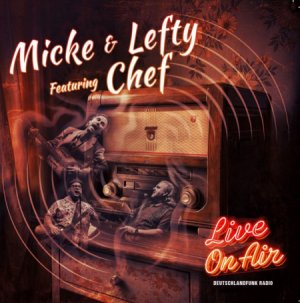 Micke & Lefty featuring Chef – Live on Air Micke & Lefty featuring Chef – Live on Air
Hokahey! Records – 2025
https://www.mickeandlefty.com
25 tracks; 1 hour 41 minutes
With Live On Air (2025), the Finnish blues trio Micke & Lefty feat. Chef offers a raw and dynamic double live album, showcasing both covers and originals capturing both the intimacy of the studio and the fire of the festival stage.
Recorded in collaboration with Deutschlandfunk radio, Volume One offers the stripped-down precision of a 2020 live studio session for DLF Radio’s On Stage program, while Volume Two roars with the raw energy of their 2023 Blues Baltica Festival performance in Eutin, Germany. Across 25 tracks—originals and time-honored blues classics—the Finnish acoustic power trio showcases 25 years of musical chemistry, inventive instrumentation, and deep blues soul.
Reflecting on the significance of the LP, which also celebrates the trio’s 25th anniversary together, Micke Björklöf said “Reaching this milestone is incredible, especially when this all started as a spin off of my main band. We wanted to share these recordings as a tribute to our long journey and audience. This live album is a real deal, raw performance as live as it can be with no overdubs.”
The album is inundated with funky rhythms, hot slide guitar, energetic harmonica, infectious bass lines, rock steady percussion, and passionate, yearning vocals. The trio remain fundamentally grounded in the blues, but venture into blues-rock, country, folk, and pop. Lefty Leppänen wrote 11 of the 25 songs performed and the group covers songs by Robert Johnson, Willie Dixon, and Miikka Kivimäki.
The Baltica Blues Festival performance opens with Chef’s wailing voice on “I’m Lost Without You”, straining, full of emotion, singing “baby you’ve been gone so long… What’d I do to cause you to leave me?” An explosion of high powered, fast moving blues ensues, with snappy, energetic harmonica and Björklöf providing an avalanche of hard hitting percussion. The live energy is palpable, with dizzying guitar and harmonica solos.
Spicy, sensual guitar starts “The One”, a suspenseful simmering track from the DLF Radio recording. Tension and aggravation come through as Chef sings “Standing on the corner of the street, seeing the merciless black sky… it’s you I’m thinking about.”
Strong storytelling threads throughout the double album. “Good Friend” on Volume I kicks off with haunting, chilling guitar as Björklöf sings, coming in and out of falsetto “Love got me singing them down and out blues… Good friend, somebody to ease you when the blues got you feeling low… Good friend, better than gold. Gives a hand when there’s nothing to hold.” Harmonica reverberates and howls like a soul crying out in the night, with clear skill. The song lingers on, a dark, yet hopeful meditation.
While the band proves themselves to be solid studio musicians, delivering smooth, polished soulful tracks on Volume I, they deliver high energy, impassioned performances on Volume 2, clearly energized by the live crowd.
“I’m a Guitar Man”, a funky blues dance number employs gnarly, gritty guitar and slow, irresistible bass lines (provided by Chef). A freight train of steady rhythm pours forth, with guitar prowess on display by Björklöf and Leppänen. The track oscillates between fast and slow, and at its height is a frenzy of funky blues, and the band is clearly in synch, propelled by the crowd.
Mean, growling guitar opens up “Hoochie Coochie Man”, the Willie Dixon song most famously covered by Muddy Waters and an inspiration for the Rolling Stones. Shouting, groaning, and moaning, passion comes through as Leppänen sings “I’ve got a black cat bone, and a mojo too. In their fresh live interpretation, a spicy blues stew emerges – a testimony to the power of blues in general.
Leppänen displays incredible vocal range on “If I had a Possession Over Judgement Day” – growling, howling, crooning, and calling in falsetto on a song driven by funky blues guitar rhythm. The high energy song contains bursts of guitar and fires on all cylinders, and at one point Leppänen screams out into the audience.
The trio of singers howls and growls on Volume 1 as well, if a bit more restrained. Melancholy, deep guitar notes and strumming open up “Gotta See My Church” and Björklöf sings “When I grew up, I had great plans to get out there do some song and dance. Years went by… Gotta see my church til the day I day.” A catchy blues riff repeats, offering soul and vitality and the interplay between bass and guitar is fantastic. The vocals pour out strong and true and a chorus echo’s the lead singer’s lines.
The trio leans into honky tonk country blues, with multiple layers of sound on “Big Bill Blues”. On the rollicking, good-spirited blues about abandonment, they sing “You know I woke up this morning, feeling sad and blue. My baby left me and I don’t know what to do.” Tasty guitar twang rings throughout.
On Live On Air, Björklöf, Leppänen, and Chef prove themselves to be energetic, authentic blues performers. The double album offers intimate, polished blues in the studio and raw, foot-pounding entertainment at the Blues Baltica Festival. The Finnish group’s chemistry, built up over 25 years is palpable and they deliver a brand of funky, high-powered blues. This double album is an excellent introduction to their work and a testament to their long dedication to live blues.
Writer Jack Austin, also known by his radio DJ name, Electric Chicken (y Pollo Electrico en Espanol), is a vinyl collector, music journalist, and musician originally from Pittsburgh.
|


Featured Blues Review – 6 of 7
|
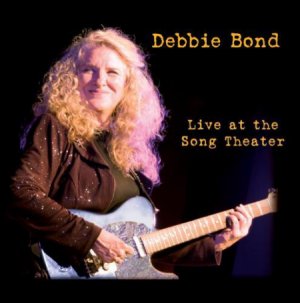 Debbie Bond – Live at the Song Theater Debbie Bond – Live at the Song Theater
CD Baby
www.debbiebond.com
12 Tracks – 52 minutes
Debbie Bond was born in California but moved to Europe and then Sierra Leone, West Africa with her family where at age 13 she played her first performance. In 1979 she returned to the U.S. and settled into Alabama where she started making the rounds of juke joints and festivals in the region. In the early 80’s, she started playing with Johnny Shines until his death in 1992. She them worked with Eddie Kirkland, Little Jimmy King, and Alabama blues man Wilie King. She toured with the latter bluesman until his death in 2009. She released her debut solo album, What Goes Around Comes Around in 1998. She was recognized as a Blues Achiever by the Alabama Hall of Fame, inducted into the National Blues Hall of Fame and in 2023 was nominated for UK Blues Federation’s “Best International Blues Act”.
The album was recorded at the Song Theater in Columbian, Alabama. The band consists of Debbie on guitar and vocals, her British-born husband “Radiator” Rick Asherson on keyboards, harp and keyboard bass, Marcus “Jukeman” Lee on drums, and “Magic” Sam Wilson on sax.
“That Thing Called Love” is the title song from her 2014 album. Debbie explains “Love is a power so simple and strange, you just can’t explain, a mystery and magic, so simple and plain”. “Road Song” rocks out as she says, “this old road don’t own me”. “We just keep rolling from town to town”. “Watch Out for Your Heart” warns “Girl, don’t lose your head. You gotta watch out for your heart. That man’s no good.”
“Let Me Be” shifts into R&B as Debbie declares “I am trying to break the shackles locked around my heart.” “It’s a dangerous world out there filled with fear and doubt”. “Some Kind of Wonderful” written and recorded by The Soul Brothers Six in 1967 and later popularized by Grand Funk Railroad shifts into Motown with Sam’s sexy sax slithering through the song. She offers a social message as she asks, “Don’t you feel the winds of change blowin’ in the wrong direction” on “Winds of Change”.
She notes “I ain’t old but I have been “Been Around a Long Time” on the song written by Delbert McClinton, Glen Clark and Gary Nicholson and recorded by Delbert in 2013. Rick plays some sharp honky-tonk piano and a short shot of harmonica on the song. She then covers Ann Peebles’ 1972 “I’m Gonna Tear Your Playhouse Down” which was written by Edward Randle. Rick takes the lead vocal as they venture into New Orleans for “Going Back” as he notes “We’re gonna dance all night long to a zydeco beat and a two-step Cajun song”.
“She explores the contradictions of life on “Nothing but the Blues” as she chastises “You claim you’re killing for peace to set people free, but people are dying is all we can see”. On the whimsical blues shuffle “Wishbone”, Debbie expresses concerns “Went to the doctor said what’s wrong with me… She checked my heart. She checked my mind. Just one more thing he had to check my spine. Don’t take no x-ray vision it’s plain to see, got a wishbone where my backbone should be.” The album closes with “Blues Without Borders” from her 2021 album of the same name as she cries “The whole world’s in trouble, got to find our common ground. Come together people or we won’t even be around”.
Debbie delivers a fun album mixed with expressions of social concerns. Debbie and her husband have been touring together for twenty years and clearly establish a musical rapport now supported by Sam’s sax and Marcus’s rhythmic excellence.
Writer John Sacksteder is a retired civil engineer in Louisville, Kentucky who has a lifelong love of music, particularly the blues. He is currently the Editor of the Kentuckiana Blues Society’s monthly newsletter.
|


Featured Blues Review – 7 of 7
|
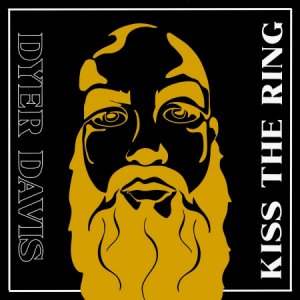 Dyer Davis – Kiss The Ring Dyer Davis – Kiss The Ring
Big Wing Records
www.dyerdavismusic.com
10 songs time – 35:26
Guitarist-singer Dyer Davis has many irons in the fire as he sings, plays guitar, writes all songs and produced. He possesses an endearing mid-western voice that fits perfectly within his songs. His guitar skills are similar, although at times they provide the charging rhythms as opposed to soloing. His band of Will Weiner on bass and backing vocals, David Weatherspoon drums + percussion, and Warren Beck on keyboards and backing vocals provide the sturdy foundation for his songs.
The record kicks off with a two-minute fast and loud rock song in “I Ain’t Lyin'”. Electric slide guitar runs wild over electric piano on “Pass It Over”, a song that almost sounds like Guns ‘N’ Roses with a good voiced singer. A crunchy riff empowers “Kiss The Ring”. It is also a good display of Dyer’s vocals. “Around The Bend” is Doobie Brothers-ish with acoustic guitar and harmony vocals. It is drenched in good vibes.
“Damned” is sure to clean the dust out of your speakers and/or ears, in a good way. The Doobies reference shows up slightly in “Brackish Water”. Tender piano, organ and what sounds like lap steel guitar render the mellow vibe of “Have Mercy”. Dyer breaks out his slide guitar again for the delightfully heavy “Laying On The Floor”. A hint of Southern Rock in “Baby”. Frustration is vented out in “Enough Is Enough” with nice guitar soloing and a dainty piano ending.
A nice revisiting of seventies style rock sensibilities. Talented vocal and compositional styles are at work here, bolstered by skilled musicianship. It is a welcome respite from blues-rock and guitar focused bands. The just right amount of guitar is added to this musical stew. It is well worth your money and time.
Reviewer Greg “Bluesdog” Szalony hails from the New Jersey Delta.
|

© 2025 Blues Blast Magazine 116 Espenscheid Court, Creve Coeur, IL 61610 (309) 267-4425 |


