

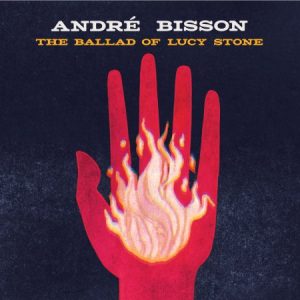
 André Bisson – The Ballad Of Lucy Stone
Self-release
10 songs – 41 minutes
André Bisson is a Canadian singer, musician and songwriter and The Ballad Of Lucy Stone is his ninth album, serving up a tasty mix of retro R’n’B, soul and blues.
Lucy Stone was a leading suffragist and abolitionist in the mid-19th century, who dedicated her life to battling inequality on all fronts. She was also, for trivia fans, the first Massachusetts woman to earn a college degree. And her story reflects the overarching lyrical theme of the album: that we cannot avoid obstacles and difficulties in life, but we can decide how we are going to face them and how they affect us.
The gritty, bluesy title track kicks the album off in fine style, with Bisson’s overdriven guitar giving the song a classic blues-rock feel, but the massed backing vocals of Theresa Hale-Charters, Quisha Wint and Selena Evangeline and the strings and horns added to the middle section suddenly dragging the song into 1960s-R’n’B/soul territory, but with modern musical muscle.
“Missing You” stays squarely in the Stax/Motown groove, with superb horns from Pat Carey, Gordon Aeichele, Loretta Hale, Shawn Moody and Rob Somerville, while the ballad, “Release Me” with its glorious vocal harmonies, could have been written for Bobby Blue Bland. Things get funkier with “Golden Handcuffs”, albeit still within the same classic soul style, calling to mind Sam & Dave’s “Hold On (I’m Coming)”. By contrast, the acoustic “Dancing With Ghosts” starts out with what sounds like a nod to “Stairway To Heaven” with its acoustic finger-picked guitar and Lizuarte de Sousa’s flute, but almost immediately goes off on a frolic of its own with a variety of instruments adding different different tones and timbres.
Bisson has an excellent, emotionally vivid voice and he is a more than solid guitarist. This is not an album packed with guitar solos, however and it is all the better for that. Bisson’s focus is very much on the song and the message and he is a very, very good songwriter. He also contributes mandolin, tambourine and backing vocals and he is ably supported by a fantastic band, comprising Jesse O’Brien on piano, organ and keyboards, Mike Rowell on bass and Keagan Early on drums and percussion. In addition, Dan Rodrigues adds Dobro, piano and accordion, while Paul Barna adds violin and viola.
“Caught!” leans into a blues-rock sound with a great vocal from Bisson and another excellent horn arrangement and unexpected middle-eight that elevates the track above being a simple blues-rock number. Bisson is always trying something novel or different. The minor key blues ballad features some lovely clarinet from Kevin Matthews on its introduction and another excellent vocal performance from Bisson and an off-the-wall solo from Moody.
“Sounds Of Redemption” starts out as an acoustic country blues track with just Bisson’s voice and acoustic guitar, before other instruments gradually join (particular kudos to Rodrigues’ subtle Dobro), creating a roaring whirlwind of music. It’s a masterclass in how to use dynamics effectively.
The Latin-tinged “The Greatest Mistake” precedes the closing upbeat country blues of “Down The Line” with Early capturing an irresistible rhythm that drives the song like a speeding train on the edge of control.
Bisson wrote all 10 songs on the album, as well as producing it (with expert engineering and mixing by Wayne Cochrane and mastering by Chris Crerar), and everyone involved deserves credit for capturing a fabulous sound.
The Ballad of Lucy Stone is a very impressive release that bears repeated listening. It probably sits more in the soul/R’n’B camp than the pure blues camp, but there are more than enough blues influences here for any fan of someone like Bobby Blue Bland, Little Milton or Johnny Adams to enjoy.
