

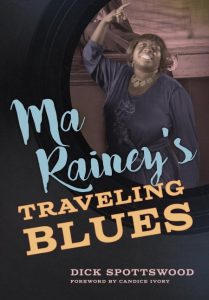
 Dick Spottswood – Ma Rainey’s Traveling Blues
University Press of Mississippi
https://www.upress.state.ms.us/
260 pages
There was no one more important in the dawning of the recording industry than Gertrude “Ma” Rainey. Billed as the “Mother of the Blues,” the Alabama-born, Georgia-raised contralto recorded dozens of sides between 1920 and the mid-’30s – many of which on the Paramount label and primarily dealing with love, sexuality and racial oppression — are still being covered often today.
But despite her fame and the fact that she’s been immortalized on stage by the play and movie Ma Rainey’s Black Bottom, her life has remained somewhat of a mystery, including the year and date of her birth. Since her passing from a heart attack in Columbus, Ga., in 1939, there’s only been one previous biography – Sandra R. Lieb’s 1981 book, Mother of the Blues: A Study of Ma Rainey.
But it’s nothing like this highly detailed and scholarly work by Dick Spottswood, the 89-year-old musicologist whose previous major works have dealt with bluegrass, ethnic and folk music while penning liner notes and more for Bear Family, Rounder, Columbia, Arhoolie, Flyright, Yazoo, Biograph and a host of other labels.
With multiple degrees in library science, Spottswood has always been an amazingly detailed researcher. And the words of this heavily illustrated bio run, which actually run only 164 pages. They weave Rainey’s life, career and importance into a tapestry that includes a heavy dose of early blues history and the cultural forces of race, gender and class that made her the person she was.
The author’s research includes information drawn from long-forgotten interviews conducted in her lifetime, contemporary accounts and lyric quotations from Ma’s music, too. He uses the remaining 100-or-so pages to deliver a timeline of Rainey’s life followed by a complete discography of her 78-rpm. records, the lyrics of all of her songs, 20 pages of footnotes and a bibliography of all of his sources.
Following an introduction by 2025 Blues Music Award nominee Candice Ivory, Spottswood paints a portrait of the multiple challenges she faced as a black, bisexual – she was married, but penned several songs with thinly veiled lyrics about lesbianism — woman having to deal with the entire dynamic of being literally at the birth of the recording industry while being an outcast in society.
Despite Wikipedia listing her birth in 1886, Spottswood cities a 1900 census report that shows that Gertrude Pridgett came into the world in 1882 in Russell County, Ala. After her family moved to Georgia, she was already singing in the local revue, A Bunch o’ Blackberries, at age 14 before running away to join the vaudeville, tent and variety show circuit as a blues shouter, dancer and comedian who traveled the South. It was while she was in a minstrel troupe owned by Moses Stokes that she met and married Will “Pa” Rainey – her co-star in Stokes’ biggest act — in 1904.
She and Pa moved on to the Rabbit Foot Minstrels, the premiere group at the time, before launching their own touring company, billing themselves as Rainey and Rainey, Assassinators of the Blues and more.
Mamie Smith recorded “Crazy Blues,” the first blues disc, in 1920 and Edith Wilson and Lucille Hegimon followed in ’22, but the whole world changed in ’23 when J. Mayo Williams discovered Rainey and brought her into the Paramount studio in Chicago to lay down “Bo-Weavil Blues,” and seven other sides that would resonate deeply with her audience and forever set the standard for other female vocalists, including protégé Bessie Smith and Memphis Minnie, in the industry to follow.
Rainey recorded more than 100 sides for Paramount in the next five years – 94 of which were released — before the Great Depression brought everything to a halt. A posthumous Grammy Lifetime Achievement winner, she’s in both the Blues and Rock ‘n’ Roll Halls of Fame, and she was immortalized in 1994 with a U.S. commemorative postage stamp. But she’s never previously gotten the exposure she receives in the pages of Ma Rainey’s Traveling Blues.
If you’re looking for an easy-breezy read, you’re out of luck with this book. But if you’re truly interested in the real history of the first generation of blues, it’ll take you in directions you’ve never gone before.
