

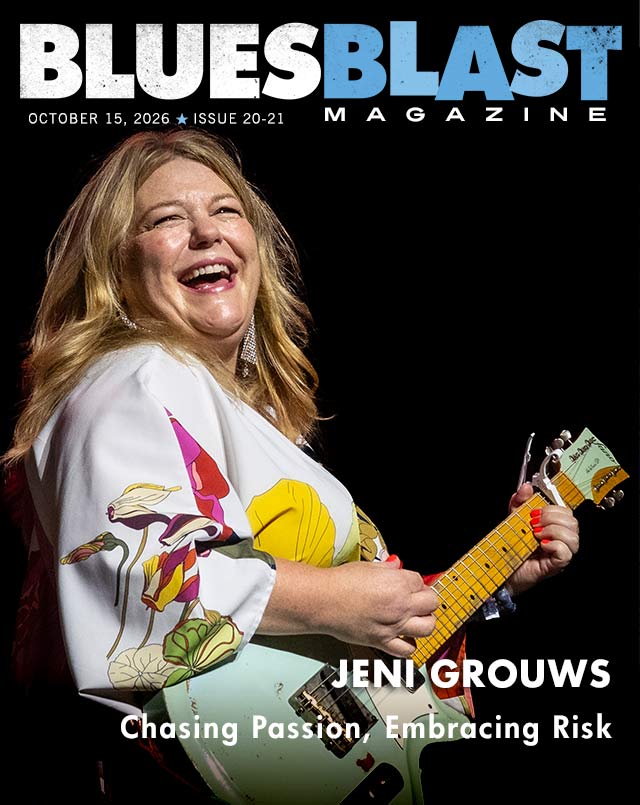
Cover photo © 2026 Marilyn Stringer
 Singer/songwriter, Jeni Grouws, seems to have a gift for feeling immediate certainty when it comes to issues regarding her future, and she is not one to be afraid to just close her eyes and jump. That courageousness and sense of adventure seems to be working quite well for her, as her first two Avey Grouws Band albums both hit the top ten on the billboard charts, their band had the opportunity to have Buddy Guy join them onstage, she was invited to perform as an artist at large at the Big Blues Bender, and her most recent album, Music House, is already receiving critical acclaim. Blues Blast Magazine had the opportunity to catch up with this warm, engaging and highly talented artist prior to one of her performances at the Big Blues Bender in Las Vegas.
Jeni grew up in the Midwest in a home that was lively and warm, but that also valued self-discipline and rational, responsible choices. She initially did not consider music as her full-time career, but she couldn’t ignore it when signs started pointing her toward her purpose. So, she made the brave decision to switch careers and become a full-time musician fairly late in life, when she was in her forties.
“I was the oldest child of a very midwestern, Scandinavian family. It was a fun home, but one that valued practicality. However, in kindergarten, when each child was filling out incomplete sentences, I filled in the one that stated, “when I grow up, I want to (fill in the blank)” with the words “be a singer”. After I graduated, I joined hobby bands that played in town and it was exactly what my heart needed, but nothing I took seriously as a career. I was working full-time as a radio station manager, doing a morning show, and was married with three daughters when I played a blues jam with some musicians in the Quad Cities. It just felt right and I had one of those moments when your stomach just tells you to ‘go, go, go!’. I felt it. I bugged those guys for eight months. I lived three hours away from them, but I couldn’t let it go. The spirit, or whatever you call it, was telling me to be brave. I started just doing some duo shows with Chris Avey, and we ended up becoming a band about a year later with Randy Leasman on bass and Bryan West on drums. But I was still working full-time at the station. Then one morning I was supposed to go in and sign a new contract with someone who had bought the station, but I woke up and said to my husband, ‘I can’t do it’. He said, ‘then don’t do it’. It was great to have that kind of support from him, because at that point my family relied on my income as part of what kept us afloat. His acceptance of it made me feel supported to go into an unknown chasm. My daughters were and are also terrific. You know someone once made a comment on one of my posts saying that maybe my daughter would want me to ‘not do this music thing’, but my daughter told me ‘I see what finally makes you happy and gives you energy, and you bring that back to us. It makes me think, if I can hang on until I get past high school, I can find what makes me happy’. I have amazing daughters. And their dad is a good man. We’re divorced now, but we’re friends and we connect about our children.”
Avey Grouws Band performed together for nearly ten years. Jeni’s beautiful vocal tone, combined with Chris’ captivating guitar skills seemed to be a recipe for success. They ended up winning the Iowa Blues Challenge in 2017 and competed in the 2018 International Blues Challenge. They released their first full album, Devil May Care, in 2020, which reached the top ten on the Billboard Blues Charts. Their second album, Tell Tale Heart, debuted at number seven on the Billboard Blues Charts. Jeni described being quite surprised about their success.
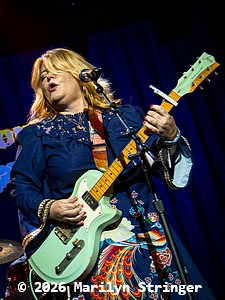 “I know there were grumblings about how we came out of nowhere, and when Billboard called us, I thought it was a hoax. I told them I’d have to call them back, and then I checked the number and called Billboard myself to make sure these people really worked for them. With the second album, I had a better understanding of why we hit the first time. We had a great fan base in the Midwest and Florida, and I encouraged them and made them part of our team, asking them to buy them as gifts for their friends. It was huge deal when our second album debuted at number seven. We did not have any management or agent. But eventually Chris wanted to go in another direction. People sometimes assume that when bands break up, that there must be some big rift, but there was not. He was getting married and wanted different things. He loves being rooted and grounded and having a sense of place. I love being on the road all the time. I could live out of a suitcase. It doesn’t stress me out—it stimulates me. In fact, I may start to panic and feel trapped if I’m in one place. But that lifestyle is not for everyone, and Chris and I just grew in different directions with the band. It was time to do our lives in a different way.”
Jeni discovered her talent for songwriting while receiving some treatment for mental health issues and generously shared this story with the hope that it might encourage others to get needed help and speak more openly about depression. Her audiences often feel a very meaningful connection to her original songs.
“My first daughter was born and three days later we had an earthquake. Two days after that was 9-11, and my whole world views changed. I was watching too much news, driving past tanks in Westwood, and I wondered, what had I just brought a child into? I had not been an anxious person before, but I had the worst case of postpartum depression. I was scared, and then I found out I was pregnant with the second child. But I pushed forward and did not have the same issue with postpartum depression with the pregnancies of my second and third daughters. But when my oldest daughter turned five, it triggered the opening of an old wound, reminding me of abuse that happened when I was five. Seeing her, it reinforced that five is so young, and what happened to me was not my fault. I had a bubbling meltdown for about a year, and I remember once thinking if I just hit a tree with my car, my family would think it was an accident. I’d be out of the internal pain I was struggling with and had never told anyone about, and they’d all be better off without me. My husband helped get me seen for mental health treatment, including trying EMDR (Eye Movement Desensitization and Reprocessing—a treatment for lessening the powerful effects of trauma). That was very helpful. I had been in a dark place, and I remember waking up one day and noticing that the world was actually brighter. Then my therapist pointed out that I was always talking about music and asked me if I had ever written a song. I said no, because I was worried about people judging me. He then wrote an actual prescription on a pad for me to go home and write a song. He must have known that I was the type that follows rules, so I went home and wrote that first song. It was ‘prescribed’ to be a nonsense song, but then it led to me writing the second song about my sister and I growing up in the country. Then I wrote a song called ‘Last Chance’. It was based on the book “The Last Lecture” by Dr. Pausch. He worked as a professor of computer science, had worked at Walt Disney and Google, and was working at Carnegie Mellon University, and they had a series focused on if it was going to be your last lecture, what would it be? He knew he was dying, and he did this whole speech about all the ways he failed. At the end of it, he said it wasn’t really for the audience, he just knew that his talk was being recorded and he wanted his children to see it after he was gone. So, I wrote the song based on that, thinking, ‘What would I want to say to you?’ What would I do? I’d spend my time saying, ‘I love you’. I have to be careful doing this song at shows because it triggers people who have lost someone. But those heartfelt, honest songs can be important to do now and then. For instance, when I recently performed my song, ‘Long Road’, (about staying alive even when things feel hard), there was this big burly tattooed man in leather from the front row who walked up to me and said that he needed to hear that, and he cried and hugged me. I’m ok with being vulnerable, and it’s great to have that kind of effect on people. But sometimes the weight of that responsibility can be a bit tough.”
Jeni then faced some compounded stressors occurring in rapid succession. At the same time as the break-up of her band, her divorce became final, her youngest child graduated high school and left home, she didn’t know where she was going to live, and she started menopause. But then things took a positive turn, when she was awarded a position as artist in residence at The Music House.
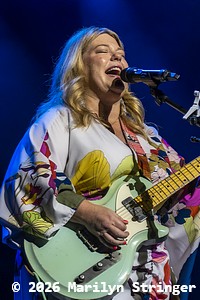 “The Music House is a single-artist residency in Omaha—a place where one musician at a time is invited to step away from the noise of everyday life and fully focus on their art. Free from the pressure of rent, the artist is given space to create in a home that is open, safe, and deeply encouraging. The residency is the brainchild of Jeff Davis, (founder of Playing with Fire and recipient of the Keeping the Blues Alive Award from the Blues Foundation), and Vanessa Marie. It was supposed to be for eight months, but they were so incredibly pleased with the connections I made that they extended me. Now I’m still there after almost two years. It’s a gift to have the peace of mind it offers, and they give you a beautiful space for a home. I love that I get to live there. It has gardens with butterflies and I’m planting tomatoes and peppers. The Music House and this residency is why this album, Music House was born. It’s based on the last five years of my Iife. It’s about feeling sad, feeling alone, scared, but also joyful of what is ahead. My favorite word is possibilities. And the Music House provided space for those possibilities to flourish. Casey Wasner was the producer for this album, and he is the chilliest, most wonderful producer. Casey is Keb’ Mo’s drummer and received a Grammy for co-producing the TajMo album. He’s worked with Robben Ford and Jason Isbell—he just sems to know everyone. I knew I wanted to do my album with him. And Casey has all these great connections, like Brian Allen, Mike Hicks, Roy Agee, Johnny Duke, and Evan Cobb. And we both knew Kyshona and Anne Harris. Drew Smithers played slide on my album thanks to Casey—how cool is that? And I said I wanted great horns on at least a few songs, and Emmanuel Echem not only pulled together the horn section but arranged all the horn parts. And I got to bring in music friends from the Quad Cities: Matt Full, Nick Vasquez and David Abdo.”
One very clever song on Music House, is a track called “Heartbreak and Misery”. The lyrics offer a humorous warning to potential suitors:
I can see you’ve got our eyes on me from across the floor
You want to come a little closer because you think you want a little bit more
But it’s a minefield, baby, in the space between you and me
Right now, you’re three steps away from heartbreak and misery.
“That’s a song about why you shouldn’t date me. I joke a lot, but any break-up is serious. Even with my ex-, it was not that it didn’t hurt. It still hurt. But eventually I wanted to date, and I jumped into a relationship with someone who was still raising a young child and was in a very different situation from what I needed. I really broke his heart and that crushed me. It almost made me never want to date again. I never wanted to be responsible for another person’s pain, especially someone I love and respect. So, I was finding peace by myself. I had never lived alone before. I went from my parents’ house to travel with a group, to living with a girlfriend, and then living with David at twenty years old and getting married at twenty-two. The peace I suddenly found on my own, especially as a people pleaser, to be able to step into a space and not feel like I must read everyone around me, constantly worrying that I needed to adjust. It was magic. I wasn’t ready to give up that peace. So, I was just sitting home, goofing around and just playing with some chords and I could hear this melody that turned into that song. And I love it. Casey really made this song come alive in the studio. I said, ‘let’s make it sound even darker.’ And he did exactly that.”
One particularly beautiful song on the album is a track called “Let Your Eyes Lay Low”, featuring the hypnotically beautiful work of Anne Harris on violin. The lyrics remind us to keep perspective in difficult times:
 There are days when the greys weigh heavy on your head
When the weight of the state of the world feels like lead
So, rest, old girl, rest.
Let your eyes lay low
Life will keep on moving
Outside your window
“I wrote that song for a lot of different reasons. I wrote it for my daughter, Lillian, who has struggled with her own anxiety in life. She struggles to understand people. She feels for the people of genocide. She feels for anyone who is the underdog. She is very educated, but her heart hurts for the world. It can take a toll on your ability to find peace and love. Sometimes I think she has absorbed too much, and you just want your child to feel happy. So, I wrote this song because I wanted her to know you can feel the troubles of the world, but the only way you’ll be any good is to take a step back and find a place of peace and release from that onslaught of humankind, good and bad. Once you reset, you can go out and fight the good fights. But you’ve got to take a breath first before you can help anyone else. I need to be reminded of that as well, and I wrote it as a reminder to others.”
Jeni has faced some challenges and struggled through many changes in her life. But she is content, and she trusts that events have led her to be right where she is supposed to be. And, although her album was just released, Jeni is already working on new projects and has written many new songs.
“I love performing other people’s songs too, but I really love songwriting and performing my own music. I can’t stop writing. I have lots of songs that I have written, although I don’t know when I can afford to do another album. Doing it alone is tough, but working with labels can also be tricky. It means you have some support and guidance. But up until now, I have done everything independently. And I like it that way. I’m also excited about some other possibilities and collaborations…I just can’t talk about them yet. I think there are endless possibilities if you keep yourself open and let your heart speak. Sometimes you have to just let go! I’m nothing special. I’m just someone who took a little chance with making this album and I’m really proud of it. I think it was the right time and the right place!”
All who witness a live performance by Jeni Grouws seem to become instant fans. And it quickly becomes apparent why she was considered the “darling of the Big Blues Bender”, and why AJ Gross referred to her voice as “stunning”. You can learn more about this talented artist, see her tour schedule, and purchase her outstanding new album, Music House, at her website, www.jenigrouws.com
