


Cover photo © 2026 Laura Carbone
 Taj Mahal…..Ruthie Foster.
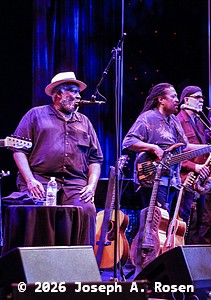
Two artists whose talent and careers place them in the top ranks for blues music. And there is another common thread between these two stellar performers. The rhythm section in both of their bands is anchored by the deep bass licks from Larry Fulcher. He is indeed living the dream!
Born in Houston, Texas, Fulcher grew up singing in the church. After his mother passed, he made the move to Orange County, California to live with his aunt and uncle, who had been a big part of his early childhood.
“At the age of 13, I had moved to Southern California. My best friend started a band, and I said, “Okay, I’m in it.” “What do you play?” “I don’t play anything.” But my mom had a piano that I still have. It’s a 1906 upright grand. I taught myself some chords, then got a little Wurlitzer piano. There were certain tunes that you had to play, like “Louie Louie,” “Twist and Shout,” “Gloria,” and “Pipeline” by The Chantays, who were in my hometown. Just to be with the band, it made me learn scales, figure out chords, chord structures, and chord voicings. I was not a great keyboard player.
“ Texas was 100% segregated at the time. I went to Black schools, had Black teachers, lived in a Black neighborhood. Racism, it was terrible. When I moved to California, you had white kids coming up asking my name, and if I wanted to be in their study group, or if I wanted to join the football team. And I’m going, “Man, this is like some reverse reality.” I mean, it was very welcome. We were just friends, period. It didn’t matter. All of a sudden I got Mexican friends, I got Samoan friends, I got white friends. I got Japanese, Chinese friends.
“It was a very culturally awakening experience, and musically, too. I’m down in Texas, hearing Fats Domino and Lloyd Price, and of course the Coasters and the Drifters, but Bobby Bland and that kind of stuff. I moved to California, and they got this stuff called surf music, which to me was- … this is goofy.
“My first gig as a musician in California, we had started our little band and one day, we were at a restaurant, and I became friends with this guy that owned it, Carey Sinclair. He knew we were into music and suggested we talk to his friend.” I said, “Who’s your friend?” He says, “Dick Dale.” “Really? Give me his phone number.”
“So he gives me Dick’s phone number. Being 15 years old and not having any better sense, I called him up and said, “Hey, man, I got your number from Carey Sinclair..” I introduced myself saying. “I got this band, and we need to play. We need some work. Can you help us out?” And he goes, “Are you guys any good?” I replied, “No, we’re great.” True story.
 “Dick says, “Well, okay. There’s this thing they call the World Teen Fair.” This was 1964 at the Orange County Fairgrounds. And he says, “I could get you guys to be one of the opening acts.” I went, “Sure.” So I called the rest of the band. They didn’t believe me, until the posters came out and sure enough, our name was down near the bottom. So my first actual groove was at a place that held about 10,000 people, my first actual gig, and we opened for Dick Dale and the Del-Tones, Jan and Dean, The Ventures, The Challengers, all these different surf groups. It was a surf guitar legend, Dick Dale, got me my first gig.
“Years later, I was playing at the Fender Museum with Taj Mahal, about 1997, and Dick Dale was there. I walked up, and told him that story, saying I’ve been in music business ever since. Dick replied, “Well, I certainly hope you don’t blame me. It’s not my fault. You talked to me!”
Once Fulcher got his foot in the music business, it took one of those fortuitous twists of fate to set him down the path that came to define his life’s work.
“One day we were rehearsing a Herb Alpert tune, I don’t know if it was “Taste of Honey”, and the bass player didn’t show up for rehearsal. So I walked over, picked up his bass, and it was so natural. It’s like, “Shit, I can do this.” I can stand up and be cool, the bass being a much cooler instrument at the time than playing keyboards. That’s what started me playing bass, our bass player didn’t show up for rehearsal.
“I had been listening to a lot of Motown because, as a Black teenage guy, you wanted to be a Temptation. But I couldn’t sing or dance, or wasn’t tall enough to be a Temptation. But those James Jamerson bass parts on the Motown records killed me. I started out by learning three Four Tops tunes – “Reach Out,” “Standing in the Shadows of Love,” and “Bernadette.” That gave me a strong foothold into playing the bass.
“Another reason I played bass was I walked into a music store, and one of the salesmen there said, “Hey, man, I got this gig at…” It was the most popular teen club in Orange County at the time. And he says, “I need a bass player who can sing.” And I said, “I’ll do it.” Now, I didn’t own a bass, so I called a friend of mine who had a bass but had stopped playing it. I borrowed his bass and amplifier. I became a full-time bass player in 1967 or 1968, something like that.
“Those days, even as a cover band, you could work six or seven nights a week and make decent bread. We got an agent, and he booked us out of Orange County to all over the States. You’d go to a town, you play in a club for a week. You go to the next town, you play in a club for a week. That sharpened my playing, but I could see that I wasn’t going to be young forever, nor did I want to play cover tunes forever. So, I said, “I should go back to school.” My cousin who lived in Minneapolis, told me, “Man, why don’t you apply to the University of Minnesota?” I knew nothing about Minneapolis, Minnesota, wintertime, snow, none of that.
“I wasn’t a great student but they offered me a scholarship paying for my tuition and books. So I said, “Sure, I’ll do it.” I flew up in April, never having the sense to research what Minnesota was about. It was 18 degrees when I arrived. Oh my God, what have I done? But I love Minneapolis, the university, and the music that was there. It wound up being a really good transitional point in life for me.
 “Once I graduated, one of the department heads liked me, so I got a job as a teaching assistant for freshman English. So I figured, “Okay, I could be a college teacher. I’m still young, got access to books, music, and girls! I was still single, so I was fairly content. I’ll never forget, it was the first week of October. I woke up one morning and looked out my window, and it had snowed seven inches overnight.
“Then my phone rings, and it’s the drummer that I had been touring with in LA. He goes, ” What are you doing?” I replied, “I got this gig teaching freshman English in Minneapolis. What are you doing?” He says, “Well, I’m playing drums for Smokey Robinson. He needs a bass player, we’re about to start this album, and he was going to hire somebody, but I told him about you, so he said to give you a call.” My mind started spinning.
“So I said, “What if I just come out and do the album, and I come back?” And he goes, “No, he needs a permanent full-time bass player, and there’s other session work I can get you.” I was hemming and hawing, and then I looked at the snow, and asked, ” What’s the weather in LA?” He said, “It’s 85 degrees.” I told him to get me the ticket and I’d fly out the next day. That is how I was snatched back into the world of music. This was 1977. They say you get used to it, but I was in Minnesota for three years and never got used to the snow and cold.
“Doing those sessions for Smokey Robinson was very interesting. I was working with the band and the producers, and Smokey wasn’t there. Because I have a fairly high vocal range, I cut all the scratch vocals for the song demos And I’m thinking, “This is crazy. I’m in the studio. I’m recording, I’m singing songs for Smokey Robinson. He’s going to cover my vocal. This is crazy. This makes no sense at all.” But it happened, it worked, and I started getting more and more session work, and there was no snow in Southern California. So I was back in the music business.
“It was like parallel realities. I met The Crusaders, and they decided to produce the band that I was working with. I have a lifetime of gratitude to The Crusaders, who took me under their wings and let me hang out, and had me doing sessions with them. That was my finishing school. That was my PhD, the time I spent working with Joe Sample and then Wilton Felder, Stix Hooper I could never thank those guys enough for their friendship, and for their mentoring.
“That band did a combination of R&B, and jazz, and reggae. One day, one of the guys said, “Hey, let’s go to Jamaica. I know Sly Dunbar and Robbie Shakespeare, let’s go down there and maybe we can get them to play on some of the tunes we’ve written.” I had never been to Jamaica, so we went, and the story of getting to the studio is probably a book in itself. When we got there, there was full-scale rioting going on because Ronald Reagan and Norman Schwarzkopf, the International Monetary Fund had devalued Jamaica’s currency and opened something called Operation Eradication, to get rid of all the weed fields. There was an an uprising in Kingston, and that was going on full time when we landed at the Kingston airport.
 “We got a taxi driver who said he would take us as close as he could to the studio. There were soldiers in the streets, armored vehicles, and Jeeps with .80 caliber machine guns. By the time we’re in Trench Town, the driver says, “You got to get out and walk the rest of the way.” So being stupid, we get out with our guitar cases on our back. People who were actively in the midst of rioting saw us with these instruments and befriended us, asking us, “Where are you going?” We said, “We’re trying to get to Channel One to meet Sly and Robbie.” So people were walking us block by block till we got to Channel One Studio, and met Sly and Robbie. At one point, one of the keyboard players had to leave. So I said, “Well, yeah, I could do that.” Reggae keyboards are more percussive than all that kind of Beethoven stuff.
“I spent a day recording with them as a keyboard player. They never knew that I was really a bass player. From that, I started getting reggae sessions, whether it was down in Jamaica or a reggae act that came to the States, a Jamaican artist. A lot of times I would get calls to tour as a keyboard player. I met some great people, like the guys from Third World. I wound up doing an album with The Wailers at Bob Marley’s house. I loved the music. It just spoke to me. Jamaica spoke to me. I fell in love with the food and the culture and with the musicians. To this day, The Wailers that are left are still my friends. Steel Pulse are still my friends.”
In the early 1990s, Fulcher made friends with a group of fellow musicians, eventually landing a weekly gig at an LA club called the Mint as the house band. That simple beginning was the start of the Phantom Blues Band.
“A great British producer, John Porter, was producing different R&B records, including Maria Muldaur, so he got me in her band for two years, and then he started producing Taj Mahal. On Taj’s Dancing the Blues record, that’s all of the current Phantoms except for me, because I was out with Maria Muldaur. But when I came back, I joined the band to do the promotions in1993, and then I started working with Taj. Because I had this background from R&B, and I’d worked with The Crusaders, as well as so many Jamaican acts, he didn’t have to explain things to me. It was a natural fit.
“The Phantom guys all knew each other, because three or four of them had been in Bonnie Raitt’s band, plus they were all Texans, so when I got called to jam with them, I was just another Texan. We weren’t the Phantoms at that time. We were called Padlock or something like that. But we just had a natural affinity for each other. We all joined Taj en masse. As we were touring, doing the promotions for Taj’s Phantom Blues album, our emcees would introduce us as, “Here’s Taj Mahal with the Phantom Blues Band.” We said, “That sounds pretty cool. We’ll keep that.” We were the band on that album, so that’s how the name came about.
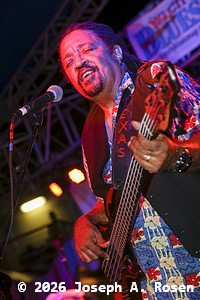 “There’s nobody like Taj out here. The guy knows music. He’s studied the history of music, how it flows, where it started in Africa, and how it migrated. And believe it or not, that was my major in college, how cultures migrated. So our meeting was very fortuitous. We had the same curiosity about the movement of culture, how cultures react, how they’re formed, their art forms, their music, and how that music travels, and a lot of it was through trade. You had to be able to communicate with the person you were trading with, so the ships would take you from one port to another. Music, along with spices and culture, was a movable, growing, and ever-spreading thing, a never-ending process.”
Taj Mahal’s latest album, Time, on Resonatin’ Records, features the Phantom Blues Band with New Orleans keyboard ace Jon Cleary filling in for the late Mike Finnigan.
“Tony Braunagel, our drummer, and I produced it. Tony’s my brother. He’s a piece of work. We’ve been bugging Taj for years that we weren’t done. We did “Dancing,” “Phantom,” “Senor,” and then we did the live album. We just felt that we had another album to complete. And this one, we got it out, it’s on the marketplace, and people are really liking it. The response has been wonderful.
“The title track, “Time,” is a song Bill Withers gave to us. He had never recorded it. But before he passed, he handed it to Steve Berkowitz, a producer friend of ours, saying, “See what those guys think of it.” We heard the tune, and fell in love with it. It’s up there as one of my all-time favorite Taj tunes. And don’t get me wrong, I love “Queen B.” I love “Senor Blues.” I love “Lovin’ You Baby.” I love all those tunes. But this one tops them.
“We also do a cover of Bob Marley’s “Talkin’ Blues.” I had no idea he wrote that song for Taj. Taj and I are famous for our 2:00 or 3:00 in the morning phone calls. So I called him. I go, “Taj, man, what do you think if we do Bob Marley’s ‘Talkin’ Blues?'” And he starts yelling into the phone. “Man, Bob wrote that song for me.” And it’s true. They were really good friends. I’ve known Ziggy Marley since he was 13, so I asked Ziggy to come in and sing the bridge, which he did. He said, “Man, this is like I’m recording with my uncles. Thanks for calling me.”
The connection with Ruthie Foster was another of those chain of events that brought like-minded souls together. It took leaving California for Austin, Texas, and while the initial rationale was monetary, Fulcher soon struck musical gold again.
“Well, that’s my heart. That’s my little girl. I moved to Texas in ’92. I moved to Austin because I had enough. I grew up in Southern California, from ’62 to ’92. I saw a lot of evolution. I saw prices go crazy. Then I had a daughter, and I didn’t necessarily want her growing up in LA. My wife’s mother lived in Austin, so we went down for a visit. Just started looking around, realized I could get a house. We were paying $1,500 bucks a month for rent in LA. I could get a house in Austin for $380 bucks.
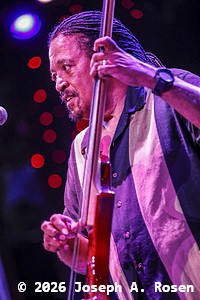 “That changes a lot. My wife worked for an airline, so I had access to travel. I could be anywhere I really needed to be because it was in the middle of the country. Next I met the Antones, Clifford and Susan, and they started… well, they inducted me into the Antone’s house band by putting my name in all the advertisements without ever talking to me. My wife would say, “You’re playing at Antone’s Saturday, aren’t you?” “No, I’m not.” She goes, “Read the newspaper.” Working at Antone’s, I met some other musicians who had a reggae group, the Killer Bees.
“They would tell me about this lady named Ruthie Foster. She did some sessions, some background vocals, and she sang just wonderfully. So, when Taj and the Phantoms were going to play in Austin, Taj says, “Man, who should we get as an opening act? You guys are from Texas.” I said, “There’s this girl named Ruthie Foster, she’s going to blow you away. I think you should get her.” Ruthie just had a duo at the time, just her and a percussionist. But she had a voice from God.
“I was doing a session with her drummer, this lady named Samantha Banks, and she was saying, “Well, I don’t know what we’re going to do.” I go, “What’s wrong?” She goes, “Our bass player, she just quit. We got this tour, and she just…” I go, “Well, the question as musicians always ask, what does it pay and how long? How much, how long?.” She said, “Let me get Ruthie on the phone.” And Ruthie just says, “If you would do it, I’ll pay you whatever. I’ll meet your salary request.”
“That was in 2014. I’ve been touring and recording with her ever since. I just turned 78 years old the other day. There’s only two people that I would leave the house to tour with, and that’s Ruthie and Taj. I consider them both iconic in what they do. There’s only one Taj. There’s only one Ruthie Foster. Well, there is Mavis Staples, but after Mavis, there’s Ruthie Foster. She makes the hair on my arms stand up.
“We feel that playing with her. It’s a performance, but it’s almost like a church service or a spiritual experience. She never mails it in. She brings it every night. We put together a really good band around her. And going from her to Taj, especially when I’m on things where I get to play with both of them, it’s like, “Oh my God.” And people say, “What’s it like doing both?” I have to admit, it’s pretty dadgum cool.”
Fulcher received a Grammy Award for the Shoutin’ In Key live album that Taj Mahal released in 2000, backed by the Phantom Blues Band. He also has been the producer on several award winning projects in recent years.
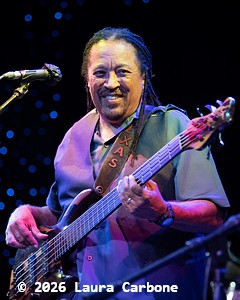 “I produced Dylan Triplett’s first album, and the second one that I produced is going to come out soon. It’s got some great material on it. And I’m contracted to do a third one for him as well. I also produced three albums for a young lady named Annika Chambers. The last one, Good Trouble featuring her husband Paul DesLaurier on guitar, got the Blues Blast Music Award for Soul Blues Album of the Year. We have a Phantom Blues Band record that we hope to get out the first part of next year. There’s also a young lady from Mexico City, Evelyn Rubio, who lives here in Houston. She’s a brilliant sax player, vocalist. I produced one album for her that the Mexican Tourist Board used as kind of their theme song when they’re talking about tourism for Mexico. I’m finishing up another record for her right now.
Knowing just a few of the key moments in Fulcher’s life, one can easily understand the pride he takes in his accomplishments, and his gratitude for all of the people that helped get to this most special place in his life’s journey.
“It’s been a long, strange trip, and music has taken me from East Texas farmland, Klan country, to every part of the world pretty much that I’ve ever wanted to go to, and got paid to be there, which is such a blessing. There is a God, because I always wanted to see this Earth. I just never knew that I would get to do it in that fashion.
“I’m thankful every morning I wake up. I have a wife and a daughter who put up with me being a musician, even the times they wanted to strangle me because my schedule is so crazy. One of the things my mother told me before she passed, she goes, “I really don’t care what you wind up doing in life. Whatever it is, you just make sure that you’re one of the best that ever did it.” I’ve taken that into music, always trying to do my best.
“One day, me and Mike Finnigan, keyboard player for the Phantom Blues Band, had finished our show, and we’re smoking cigars, sitting backstage watching Mavis Staples. We’re both in our 70s at this time. I go, “Fins, this does not suck.” And he goes, “Are you fucking kidding me? For us to be this age and have gotten away with living this lifestyle for all these years, and we’re still here?” He added, “Man, we’ve already won. We’re playing with house money.”
“And that stuck. We were playing with house money a lot longer than a lot of people. So I feel like a very fortunate and blessed and grateful guy. You don’t ever know. Mike Finnegan’s passing was a spirit crusher to all of us. It hits me every day, at least once a day. Finnegan left us here with this bullshit. I just miss him.
“I wish that everyone could get along in everyday life like they do when they’re at a concert. We played in places and countries where no one spoke our language. But as long as the music is going, you have a community. It’s just such a positive experience. I think that one of the reasons God put me here, and made me curious about how culture moves, was so I understood my part and my role.
“It’s certainly not logical. No one goes into music because you’ve got good common sense. You have to have serious mental defects to do this for a living. But I’m so appreciative he chose me to put in this role. That’s what I have to say. I’m just thankful and appreciative, and I hope that some of the music that channels through me, because music comes from on high, and it channels through us, and we disperse it and dispense it. I hope I’ve been a good vessel, a good channel.”
