

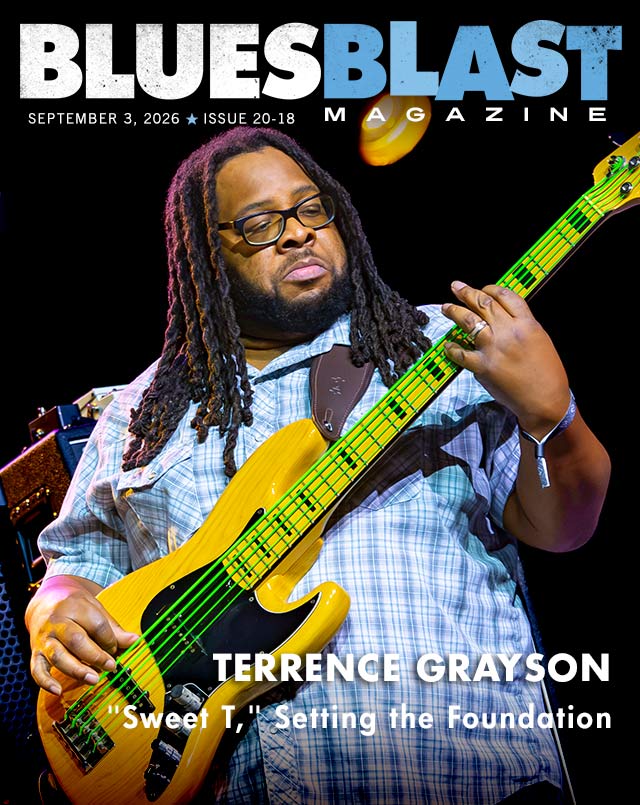
Cover photo © 2026 Marilyn Stringer
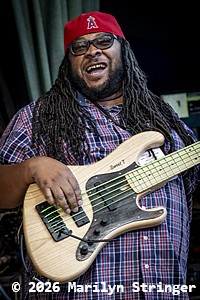 Most blues fans would instantly recognize the names – Bobby Rush, the late Michael Burks, and Victor Wainwright. They each have a definitive style, with one common denominator being their ability to consistently deliver mesmerizing live performances for fans around the world. And if you have been paying attention, you would know that the all three of them have had a certain bass player setting the tone for their bands.
Born in Jackson, Mississippi in 1980, Terrence “Sweet T” Grayson has a resume that leaves no doubt that he is a rhythmic powerhouse who has taken full advantage of his musical opportunities..
“I have a lot of church background. My mom and dad both play. My mom still plays piano and organ in church while my dad was a bass player. Actually, my family was the church’s band, with my brother playing drums, and my older sister was the choir director. I played whatever was open, which ended up mostly being playing keyboards up under my mom. But I always wanted to be a guitar player, but- … we always had really good guitar players. I played some drums as well.
“I thought the guitar player at the time was just such a cool guy, and he was one of the first guitar players that I had seen that would come to church with some shades on while playing, and I thought he was the coolest thing going. I switched over playing keyboards, and once I got in junior high school, I started playing trumpet but mainly just the rhythm section instruments – keyboards, guitar, bass. I never did get good at guitar, and when I found out how hard it was, I figured maybe guitar ain’t for me. I just wanted to be like the cool guy that was wearing the shades. And he did have a pretty wife!
“I always wanted to play. My parents were always traveling, going from church to different churches with the choir. What’s crazy is my dad didn’t even play a musical instrument, even though in his whole family, we have just tons of musicians that play professionally. My dad was a car mechanic who liked to hang out in the streets. My mom told him, “If you want to date me, you got to stop racing them cars, get out of them streets, and you got to learn how to play an instrument.” So he bought a bass guitar, then she taught him how to play.
“We just grew up around it, practicing in our garage every night, and getting the cops called on us. They would come and sit out there for about 20 minutes before they even knocked on the door because they was enjoying the music. They would tell us, “Hey, sorry to bother you guys, but your neighbors, they want to sleep.” My dad was real stern about somebody messing with his guitar. So I used to sneak around to play his bass, and by the time he found out, I actually knew how to play it.
“The bass is the foundation. If the bass falls out, you definitely know it. If you don’t have a keyboard player with a dominant left hand, definitely the booty is going to fall out of the groove if the bass is not there. I like setting the groove. My dad used to really thump that thing. You can feel him coming up the road to the church, thumping that bass. I switched from trumpet to playing the tuba because I just wanted to play them bass lines.”
Grayson ended up playing so much that he didn’t finish high school. He got a job and worked on getting a GED degree, which his mother insisted on. Playing at another church, he met someone who set him down a new path.
“I met Larry Milton, a local blues singer. He said, “Man, I really like the way you play. You ever played blues?” I told him no. “Well, you want to play in my band?” I was like, “I don’t know if my mom will let me do that.” He was like, “Well, we’ll work that all out. Just come over to my house to rehearse.” So, I started hanging with this guy, and he had a drummer that worked as a janitor at the school that my mom was teaching at. The drummer asked her, “Mrs. Grayson, do you got a son named Terrence that plays bass guitar?” When she said she did, the drummer said, “Oh, okay, I’ve been playing with him.” But she was thinking I’m playing at church. Every Wednesday night when I would leave, she was thinking I was going to choir rehearsal, Bible class, or something to play at this church.
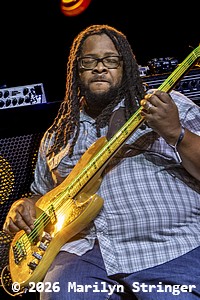 “Meanwhile, I’m playing at the nightclub at 17, 18 years old. Maybe a year or two had passed by, and from time to time the drummer would mention to her, “Saw your son again last night.” One time he mentioned that we were playing a blues festival outside of Jackson somewhere. And she was like, “Blues? I didn’t know you was playing no blues.” That’s how she found out that I had been playing in these blues clubs every Wednesday night. I did it for a long time before she found out, though.
“My parents didn’t take to that well, but by that time, I moved out of the house with her and moved in with my oldest sister. So, then Mom was like, “Oh, well, you grown now. You can do whatever you want to do, but you better stay safe out there and make sure you keep God first.” That was the main thing, keep God first in whatever you do. And so now they’re super proud of me from the different things that I’ve accomplished out here and in my music career.”
It took one of life’s little twists of fate to give the bass player a golden opportunity.
“My first professional touring gig was as a member of the Bobby Rush band. I was playing with this gospel group called the Gospel Shining Stars with my cousin and one of my best friends, Terry Richardson, who passed a couple years back. When he passed, he was the bass and keyboard player for Bobby Rush. They had a bus company with a bus yard, and they used to do all of the mechanical work on Bobby’s buses.
“From time to time, they would drive for him. So me and my cousin would always just tag along with them to gigs, go to festivals. Then I started doing guitar tech work for Terry, tuning his bass guitar for him in soundcheck and help set his stuff up. He was one of those guys that really loved women, and he was out there messing around with one of them and didn’t make a sound check. Just being around, I had learned Bobby’s whole show, which gave me a chance to sit in during that sound check. Bobby was like, “Oh, young man, you can really play.” Later on, he gave me a chance.
“When the opportunity came along, I jumped on it. I cooled with him for about, what, 10 or 11 years, something like that. He really groomed me as a touring musician. My mom knew of him. Mom’s from Byram, Mississippi. Her mom lived down there in Byram on this little one-way street that you go down, it’s like a little country neighborhood. Next to the house was a bus covered with bedsheets. And in her house, there was a wing-back chair with a resonator guitar and a picture of this old Black man on it, in one of those shotgun houses where you run through the front door straight down the hall out the back door.
“We kids be playing in there, and she was like, “Y’all better be careful running out through there. You better not knock over Chester’s guitar.” And at the time, I didn’t know who Chester was. I remember the day that this big tow truck came and pulled that bus off the yard. Years later, come to find out Bobby Rush was out there to pick up that bus. It was part of a feud that him and Howlin’ Wolf had going on. Howlin’ Wolf took the bus from Bobby. Bobby wanted to steal it back. Howlin’ Wolf stole it back from him and hid it down there in Byram, Mississippi.
“So when I was maybe like four or five years old, I crossed paths with Bobby Rush. And then later on, hearing him tell that story, I was like, “Bobby, I was one of them kids that was playing out there in the yard when you came and picked that bus up.” So needless to say, my grandma’s first cousin either dated or was married to Howlin’ Wolf.
“I was already kind of a part of the history before I even got a chance to get into the music. I always think back about that, “Man, I was playing around Howlin’ Wolf’s guitar.” Could’ve knocked it over and probably got my butt whooped real bad! Once I got with Bobby, everything just came together. He took me all over the world. Actually, I wouldn’t have met Michael Burks if I wasn’t out touring with Bobby.”
When Grayson wasn’t on the road with Bobby Rush, he played locally in Jackson as part of the house band called Blues Eruption at the 930 Blues Club, with Stevie J. Johnson doing the vocals. They would open for touring acts.
“I met the Neal Brothers for the first time out there, a whole bunch of blues artists. Of course, Michael Burks used to play long hours of the night. The club normally would close at 2:00 am., but whenever Michael would play, I would stay there until the last note, and he would get done at 3:30, 4:00 in the morning. I had a conversation with him one night on his break. I was like, “Man, I sure hope to work with you at some point.” He was like, “Well, that time could come around, it’ll most likely happen because I love the way you boys play. You all make me work hard.” Because we were a really fiery band.”
 After doing a lengthy stint with Rush, Grayson decided the time had come to spread his musical wings a bit. Still a young man, he knew there was still plenty of music and life to experience.
“A couple years later, Michael had been through about seven other bass players within that time, and we played the Portland-Oregon Waterfront Fest, and Michael was on the other stage, across the way, playing, and I could hear his bass player at the time just basically shredding that man’s show, just tearing it to pieces.
“We did the After Jam that night, and Bobby was hosting it because we headlined the festival. Michael Burks came up, playing with us. The whole night he was just looking back there at me, just smiling. And after we got through, he was like, “Man, you a solid player, man. I love how you play.” “You ever thought about playing with somebody else?” I was like, “Yeah, I mean, I’ve thought about it.” I said, “I’m going to have to talk to Bobby about it and see how he feels.”
Burks still wanted to give his bass player a chance to get things right, but promised Grayson when the time came, he would be calling him.
“I said, “just as long as you give me enough time to do things the right way with Bobby. I don’t want to just up and leave him dry. We got to have stuff set in place.” And Michael was like, “Respect.” Maybe six months later, Michael called me, and I put in my notice with Bobby, got his new bass player ready, and I went on with Michael for roughly three years up until he passed. I was actually his last bass player.
“It took me a little while to get my bearings and my mind back together after he passed because I had never dealt with any type of situation like that in my life. We were actually coming home off the tour, off of a European tour. I think we was coming from Basel, I think. And we made it back into the States, got off the plane in Atlanta, and that’s where he ended up having complications, and they took him to the hospital. He didn’t even make it to the hospital. And it took me almost a half a year or so to kind of get myself back together.
“I did my first two blues cruises with Michael, and then after that, I did my first blues cruise with Bobby, and that’s where I met Victor Wainwright a couple of years before. We’d jam together when he was doing the piano bar, and hung out on his breaks. I told him pretty much the same thing that I told Michael. I was like, “Man, I like playing with you, man. I would love to work with you someday.”
“And years later, I get the call from him. It was after I had moved to Memphis, and was trying to figure some things out. I was actually going to Memphis to venture out in my music, and I had an audition with Ana Popovic, and I was also auditioning for B.B. King’s Blues band to go on the cruises with Holland Cruise line.
“The day before a scheduled rehearsal with Ana and her band, Vic’s guitar player called me., “Hey, we got a three-week tour, and our bass player just dropped out. Would you want to do this tour with us?” I was like, “Yeah, I’ll do the tour.” I ended up ghosting Ana, which I ain’t proud of because I’m not that type of person, and went over to Vic’s house to do a little rehearsal to see if I would be a good fit for them. That led to me being with Vic for over 14 years now. I did that tour for him, and the rest is history.
“Having said that, I’m pretty sure if Michael was still here, I would be playing with Michael. We were on our way, for sure. My resume is not a long resume. I’m not one of the musicians that just jump around. I like to stick and stay, to grow within that situation. I do some freelance gigging. I’m actually going to be with Bernard Allison coming up in October for a festival. But I like to get in a situation and help that situation grow.
“Victor used to be joking around on stage, calling me “Sweet T,” and it stuck. I do believe I am a sweetheart of a guy! Vic has been out there for a while making a name for himself. I like his band because we’re all the same age. The lineup we have is crazy. I’m so lucky to be playing with this caliber of musicians, with Pat Harrington on guitar, Sam Butts Jr. on drums. We’ve got two horn players that have been with us for maybe two or three years now, Gavin Jorgensen on saxophone and Chandler Judkins on trumpet. To me, everybody in the band, way more talented than me.
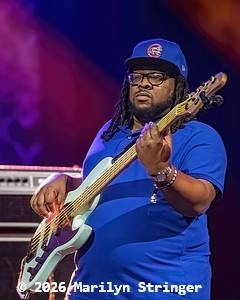 “They all have theory knowledge. I don’t have any theory knowledge when it comes to playing. I’m one of those players that just plays. We all make each other better. Once you put us together, man, we’re like the Power Rangers. Remember that cartoon, when they all get in their little machines and connect and become these big monsters, and they just win all the battles? That’s what I feel about the Train, a really fiery, just spectacular band that just goes out and kills it, man. We always putting out, we’re always leaving everything on the stage, and want to touch people when we play. You’re going to feel what we have to offer for your soul.”
Grayson’s dynamic bass lines have been featured on the two Victor Wainwright and the Train albums on Ruf Records. His discography also includes two albums with Bobby Rush, one with guitarist Eric Johanson, several with singer and harmonica player Tony Holiday, and the Show Of Strength album on Alligator Records, the last release by Michael Burks. He has recorded a solo project that he doesn’t feel is quite good enough. Those who have heard it continue to encourage him to release it.
“I actually produced the majority of the music on BigLlou Johnson’s “Big Man” album, and played a lot of the music. Me and one of my buddies out of Memphis pretty much did the whole album.. I just finished doing the music production for BigLlou’s next album, which I’m not sure exactly when it will be coming out. So we’re waiting on that to drop at some point.
“The beginning of next year, we’ll be doing two new albums with Victor. One is going to be him showcasing the piano, doing a tribute to a lot of the piano players. And then we’re going to do another “Train” album. And when I ain’t on the road, I’m here spending time with my wife Roxie and our family.”
Fender makes a number of fine bass guitars. Grayson has always been partial to the five string Deluxe Jazz model, at least until a recent development.
“About two years, Michael Delaney at Delaney Guitars designed my own “Sweet T” Signature 5-String bass guitar. It is a one of a kind, unless you want to order one just like it. What’s special about that bass is Michael put a tremolo on the bridge, along with custom Bartolini pickups. It features my colored strings, which I have an endorsement through DR Strings. When you see me playing my bass, it’s very unique looking because I’ve got these bright neon green strings. I play it way more than I play my Fender now. And as far as my rig setup, I got connected with the Markbass company through guitarist Eric Gales.”
If you go to the Delaney Guitars website, you can take a look at the “Sweet T” Signature jazz bass. (https://www.delaneyguitars.com/)
Not many musicians have the opportunity to play with three outstanding artists. It has been something of a charmed life, a fact that Grayson fully appreciates.
“Some years back, we used to do the B.B. King Festival out there in the Delta, and we would always do the after-party at this little hole-in-the-wall, cheap joint. And man, it was my first time. Buddy Guy was out at the festival, and of course, B.B. closed it out. Bobby, B.B., and Buddy got on that stage at that joint. We played till 2 or 3:00 in the morning, man. They just was going back and forth, man, just singing all them old songs. I felt like I was in blues heaven. Three legends on stage with me, and at my young age. A lot of musicians that have been out there for a long time and never got the experience of something like that.
“I’m so lucky to have had all these experiences, even though back then I didn’t have a clue. I got to stand beside Bobby Rush for so long, doing big festivals and hanging out with Tyrone Davis and Millie Jackson, Theodis Ealey. When I wasn’t intruding, I was always trying to hang around them to hear all the good stories, the blues, and get a chance to hear the dirty jokes. We were young guys, and Bobby used to tell us all the time, “You got to bring that engine! Y’all got to keep an old man up.” And most of the time we couldn’t keep up with him! After two weeks of touring, we’d be tired and he’d be still going.
“I do feel like I’m totally capable of fronting a band, but that ain’t what I want to do. For one, I don’t want to be the one that has to foot the bill for touring, because that is not an easy job. I like to be that crutch for that front person, to just lift that them up and keep the band going. That’s how I like to live my life, and I think that’s what I’m called to do, to be the best sideman that I can be.”
