

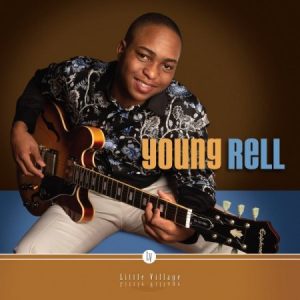
 Harrell Davenport – Young Rell
Little Village Foundation
12 Tracks – 47 minutes
In the 12 years since he started playing music, Harrell Davenport has managed not only to develop an almost masterful grasp of the blues music idiom but has also spread the word about himself with the savvy use of social media platforms. For the last four years he has been making appearances across the country and internationally, steadily growing a wider audience. He was nominated for Blues Blast Magazine’s Sean Costello Rising Star Award the last two years With the release of his first album, courtesy of Jim Pugh’s esteemed Little Village Foundation label, the full scope of Young Rell’s artistry on guitar and harmonica, as a vocalist, and as a songwriter shines at every turn, a truly amazing debut recording.
Things get started with “Tomorrow,” a steady-rolling shuffle with Davenport relating a tale about a older woman looking to make his acquaintance. When he’s not blowing some hearty harmonica licks, he politely promises to look her up at some point in the future, but his voice betrays a bit of immediate longing. His original, “Fatherless Child,” is a stark lamentation on being alone, conveyed with stunning maturity. The mood shifts on “Spinning, “ a soulful romp that Davenport wrote, his joyful vocal punctuated by Aaron Lington on saxophone and Niel Levonius on trumpet. It is the type of song that has been a staple for Johnny Rawls for years.
If you are wondering about Davenport’s instrumental abilities, just give a listen to “Richland Swing” and “Nite Creepin’”. The former is a blazing guitar workout with Davenport conjuring up the likes of Clarence “Gatemouth” Brown or Little Charlie Baty as he fires off one fiery, swinging passage after another. The later track is a rousing harmonica workout, Davenport’s full tone and clever improvisations are a marvel, at times channeling harp master James Cotton. But in the end, it is Davenport who makes a lasting impression.
Other highlights include “Giving Me The Blues,” with the singer promising to speak his mind as he struggles to deal with others intruding on his peace of mind, tightly drawn guitar licks echoing his pain and frustration. Davenport blows some mournful harp tones on “Hurt People, Hurt People” while offering his own illuminating assessment on dealing with life’s trail and tribulations. “I Be Tryin’” has plenty of the grit and grease you might find in Chicago’s West side clubs. The track gets a boost from Jim Pugh’s stellar organ accompaniment, just one of his many noteworthy contributions.
Along with his ten originals, Davenport weighs in with two bold covers. His version of Fenton Robinson’s “I Hear Some Blues Downstairs” is a joyful rendering with a sparkling vocal turn set off by beautifully crafted guitar passages. Even better is his timely cover of Bob Dylan’s classic, “Masters Of War,” turned into a full-blown shuffle that is far removed from Dylan’s solo acoustic version. Davenport sings with more than hint of anger in a strident performance that encapsulates the feelings of a new generation that faces the possibility of fighting yet another war. He drives the message home with a level maturity and vulnerability rare for his age.
The project was recorded at the famous Greaseland Studios, with head honcho Kid Andersen co-producing and engineering, plus adding guitar on six cuts. June Core is behind the drum kit while Endre Tarczy and DaQuantae “Q” Johnson fill in on bass. Larry Batiste adds backing vocals on one track in addition to writing the horn arrangements. With the horns and Pugh’s always memorable keyboard elements, it is a veteran group that brings plenty of life to Davenport’s efforts. The project was produced by another Chicago harp player, Matthew Skoller, who has been Davenport’s manager. The glowing liner notes were composed by Blues Hall of Fame member Billy Branch, another mentor and harmonica legend.
In the end, Harrell Davenport leaves little doubt that he has what it takes to build a memorable career. One can only wonder what the future will hold. The important thing is to enjoy all that this one has to offer. He may be “Young Rell”, but his blues are timeless!
