


Cover photo © 2025 Jennifer Noble
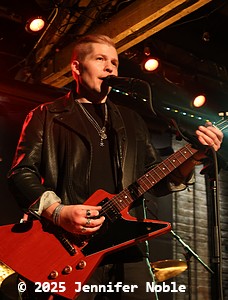 Hard rock and heavy metal might seem like genres far removed from the blues, but they actually share some deeply rooted links. Legendary blues guitarists, such as Robert Johnson, Muddy Water and BB King influenced rock and metal guitarists with their innovative bending of strings, vibrato and use of the slide, and the blues themes of persevering over periods of heartache and struggle influenced the lyrics of rock and metal too. Therefore, it’s not surprising to learn that groups such as Black Sabbath, Judas Priest and Deep Purple actually began as blues bands.
Some of today’s favorite blues artists delved into hard rock and metal before their journey brought them to the blues. Louisiana-born and raised guitarist/singer, Eric Johanson, falls into that category. Eric was born into a musical family in Alexandria, LA, (where his grandparents owned a music store), although he later moved to New Orleans. He started playing guitar at the age of five and was basically self-taught.
“My grandfather and grandmother ran Kelly Ward’s piano and organ store. We had instruments around the house and they both played. I also had an uncle that played bass and another uncle that played guitar. My aunt played bass and piano, and my mom did a little piano and singing, although none of them were full-time musicians. Also, some of our family members were in relationships with musicians, so at Christmas time there were always going to be family jams. As far as lessons, some of my older friends played, so I picked their brains a bit, and I got some books on scales to help me understand how scales fit together, but never properly took lessons. I started learning from records, trying to play with every song on the record.”
“With regard to genres, I was exposed to a lot of different music. My mom had Etta James and BB King and James Brown—lots of soul, funk and blues, and I always liked that stuff. But what grabbed me at first and made me want to get into music was definitely the heavier stuff. Metallica was my favorite band for a time, and then White Zombie. Then I started to get into some instrumental guitar, like Joe Satriani and Steve Vai, and the more I became interested in guitar the more I noticed that players I liked seemed to always reference the blues and how everything they did was started in the blues.”
“So, I got more into the blues, got to play some gigs, and started to get into writing my own music and finding my own voice. Then, I started to veer back toward rock, because it felt like rock was more fitting for my voice and for what I was experiencing at that time, so I had a rock band for a little while. But then I started playing alongside other people, like Cyril Neville, and over time I started to get more comfortable with the idea that my own approach could fit into the blues realm without having to sound like the people I could never sound like. For example, I would listen to Freddie King and think, If I could just sound like that, I would play blues. But I learned to become comfortable in this bluesy space without having to keep it inside a box.”
One aspect of the blues that appears consistently loved by fans is the authenticity and raw emotion that is poured into the songs. That element played a strong role in guiding Eric’s musical journey back to the blues.
“One of the things that kept pulling me back to the blues was that feeling and connection with the emotion that is really amazing with the blues. You’re not playing it the same way each time, you’re saying something different each night. I want to make music that explores what I’m thinking about now—I’m not interested in relying on traditional topics or old-timey language or being a throwback to something. When you’re making music, you want to connect with people in an authentic way, so that has been a goal of mine—to continue to move my feeling for the blues and make sure that’s kept in there, while exploring song territories without putting a limit on it.”
After Katrina hit New Orleans, Eric left Louisiana and lived for a time in New Zealand, which can be somewhat isolating for someone in the music industry.
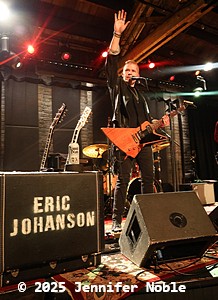 “That was really just about exploring life and getting away. I wasn’t thinking about how it would fit with my music career. I was recording and focusing on making music that was not meant to be played live, until I realized I missed playing live improvisational music. I missed playing soulful music live, in a context where people really understand. Coming from New Orleans, it’s so deeply entrenched there that you can take a lot for granted. Like the shared vocabulary. Until you go somewhere else you don’t appreciate how great it is that people can just make music up on the spot and have it sound like some beautiful thing. Just jamming with other people—I missed that, so I ended up coming back and diving right into it. Ultimately the music brought me back to New Orleans.”
Eric was drawn particularly to the music of Tab Benoit, and after meeting him, Tab came to appreciate Eric’s talent and often invited Eric to join him on stage. Eric then was invited to join Tab’s record Label, The Whiskey Bayou Label, and later started opening for Tab. (Those who know Tab well know he loves any opportunity to play drums, and Tab started joining Eric, playing drums during the opening set.) Tab later also gave Eric a job as his tour manager, which allowed Eric to make some money, and have a spot on the bus and a hotel room each night.
“I really looked up to what Tab was doing. I didn’t feel like my style was the same as his, but I am a fan of his raw approach and a fan of the power trio and of pouring your heart out and putting 100 percent into it every night. I was very inspired watching him. I kept showing up at his shows and there were a couple of times that I got to jam with him playing drums. He started having me sit in at shows and he finally said, ‘Why don’t you come by and record?’ I went over there and, at first, we just made some sounds and hung out a little bit and made a plan to make the record the next year. After we made the record, (Burn it Down), in 2017, they started floating the idea of me going out and opening for him and we did that for about two years with him playing drums with me. At first there was some push back, because it didn’t seem like a good idea to open for yourself, but somehow it worked.”
Eric noted that, while he didn’t exactly write any songs with Tab, Tab’s influence can be found on every track.
“He brought something to all of the tracks, especially “Graveyard Queen”. He really flipped the groove on that one in a way that it’s hard to imagine it any other way now. When I got there to record, I thought we should hash out song ideas, but he was ready to just push the record button and see what happened. That was cool and it definitely forced me to not think about whether something was ready. I thought, ‘I guess it’s ready because we’re recording’. There was none of thinking that you could have ten or twenty takes, like some people do. And I’ve stuck pretty much with that way of doing it, just recording it live, otherwise you can get in your head too much, and you want to stay in the inspired moment.”
In 2019, Nola Blue Records issued a duet album pairing Eric with his cousin, Tiffany Pollack, entitled Blues in my Blood. The next year, Eric had just released the Below Sea Level album (produced by Luther Dickinson) when COVID hit, and the gigs slowed down to nearly nothing. Like many other musicians, Eric resorted to live streaming some shows during COVID, which led to the release of his interpretations of other people’s music, called Covered Tracks.
Then, in 2023, he released an album on Ruf Records (produced by Jesse Dayton), called The Deep and the Dirty, which debuted at #1 on the Billboard Blues Chart. That album likely contributed to him being named as one of Guitar Player Magazine’s 25 Best New Blues Guitarists, and also likely helped him land a spot in Total Guitar Magazine’s list of 100 Greatest Blues Guitarists of All Time. Eric’s most recent release, Live in Mississippi (2025) earned him a nomination for a Blues Blast Award for best live album.
“After awhile of livestreaming, you start to play some of the same songs and start to get requests. Some fans would be tuning into the live streams and would say that they would like to have some recordings of the stripped-down acoustic songs I was playing, so I released Covered Tracks. Then I released the Live at DBA record. I had wanted to capture the band rocking out and doing what we do in a live setting. Then The Deep and the Dirty came out, so there were new songs that were not on Live at DBA, and we wanted to capture them on a live album, so we recorded Live in Mississippi at Ground Zero in Biloxi. It’s been doing really well. We’ve gotten a lot of good feedback about it, and it’s been a popular seller at the live shows. I guess the live records tend to be of interest to people who come to hear you live.”
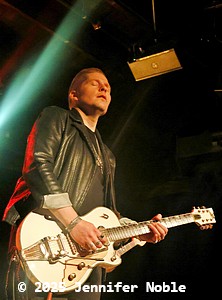 Like many musicians, Eric struggled with some substance abuse issues for a period of time but now has an extended period of sobriety. His music sounds better than ever, and it appears that he is getting some well-deserved recognition for his work.
“It’s been six and a half years since I stopped drinking, and it has given me a lot of focus and motivation. I wouldn’t have any of this going on if it wasn’t for that. For me, playing is more fun this way because playing itself has become the release rather than the release occurring later the show or before the show. The show itself is the payoff of doing all of this. I remember shortly after I stopped drinking, I realized I was selling way more merchandise and CDs than I ever had before. I could see the response was different and I was clearly connecting with people more than I was before. But, at the same time, I’m really of the mindset of whatever works for others. I have no problem being around people who are partying. I enjoy being a good time for other people and I love looking out and seeing people having a good time. I always want to encourage people to feel comfortable having a good time around me, and it doesn’t bother me at all if they are drinking.”
Eric doesn’t have a single most-requested song but always appreciates it when audiences seem to know his work and request any of his originals. One of the most cathartic compositions came when he penned “Familiar Sound”. The lyrics note: “I cross the ocean. Tried to lay my troubles down Into the sea. But they follow me right in the town. I heard that voice from the shadows. It was an old familiar sound.” The composition, “She is the Song,” was also particularly meaningful for him. And he has now gained confidence that his unique blend of blues and rock is well-accepted by audiences.
“’Familiar Sound’ is about how many times you can be trying to change the situation or the surroundings, when what you’re really needing to change is something more within yourself. I think that one gets across something that has been a big issue for me—realizing the negative things you’re telling yourself are not the truth—they’re just a sound that’s popping up in your head. And ‘She is the Song’ is an expression of how hard it is to capture some things in a song, when the thing you are trying to capture is always greater than the song. I am becoming more comfortable with my own brand of American roots music that incorporates rock & roll and blues and funk and I’m having a little more faith that the audience get it, and they’re not going to be saying ‘that’s not blues’ or ‘that’s not New Orleans music’. I’ve become more comfortable that even though I rarely play a traditional blues song, the emotional center is still going to resonate with people without it needing to be in a particular box.”
Eric has been touring extensively both in the US and in Europe. He recently played Poland and has festivals in Romania and Belgium coming up in the near future, as well as many venues across Europe. He was asked what was left on his ‘bucket list’ of musical goals that he hoped to accomplish.
“I’d love to play with Warren Haynes. I’ve been a fan for such a long time and he’s always been such a nice guy. I’ve run into him several times over the years but haven’t yet had the chance to jam with him. I’d also love to jam with Derek Trucks and would like to get to jam more often with Luther Dickinson. There are so many, but those would definitely be high on my list.”
We can only hope that we are in the audience when Eric Johanson gets the chance for any of those desired collaborations. You can learn more about this extremely talented singer/songwriter/guitarist, and you can find out where his tour is taking him next, by going to www.ericjohanson.com.
