

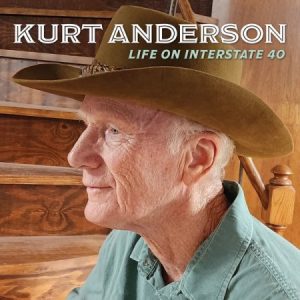
 Kurt Anderson – Life on Interstate 40
Riverlark Music – 2024
17 Tracks; 45 minutes
Across Life on Interstate 40 (2024), Kurt Anderson draws from the deep well of American roots music—blending folk, blues, Gospel, old-time, bluegrass, and classic country with a weathered voice and a lifetime of stories. While Anderson, a chameleon-like guitar player and songwriter, boasts a career spanning nearly six decades, this LP is his first solo release, much anticipated by longtime fans.
Throughout the album Anderson emerges as an expert storyteller with strong lyrical ability, backed up by simple, effective instrumentation, most notably his Martin acoustic guitar. Anderson explores timeless themes in American music, including longing, loss, love, gone wrong, and the lonesome pull of the road. Across the album, trains, highways, and drifting serve as metaphors for emotional and physical distance.
Tracks like “900 Miles”, “Mr. Engineer”, and “Hobo’s Meditation” center on the wandering soul archetype – drifting, cut off from home, searching for meaning. Heartbreak is a constant companion, whether mourned with stark resignation (“Ashes of Love,” “Stone Walls and Steel Bars”) or lingering sorrow (“Why Should I Be Lonely,” “It’s Raining Here This Morning”).
Melancholy, dramatic, skillful guitar riffs open up, “Willie Jean”, one of the strongest tracks on the album. In a deep, rumbling voice, Anderson sings “Sometimes I think of the folks back home. And the ten mile road I used to roam. Sometimes I think about a girl named Willie Jean”. Anderson’s strong vocals are all the more incredible considering his 2003 diagnosis and battle with throat cancer. The track is a simmering, spicy blues – simple, brooding, and authentic, fully demonstrating Anderson’s prowess on guitar.
Anderson’s smoky, weathered voice sings “I’m 900 miles from my home and I hate to hear that lonesome whistle blow” on “900 Miles”, the first song, a mixture of folk and blues projecting deep longing and pain. It is effective in its raw, stark simplicity.
“Will there be any freight trains in heaven? Any box cars in which we might hide?” Anderson sings in an aged, straining voice, like the weary voice of a hobo worn down by the years on “Hobo’s Meditation”. Slow, deliberate guitar picking plays throughout, and Anderson yodels with soul, like a body crying out. Excellent lyrics reflect on an itinerant lifestyle and death.
Crisp, rolling banjo carries “It’s Raining Here this Morning”, a song about a man abandoned by a woman for a crime he did not commit. The banjo, played by Randal Morton, is persistent, bright, and expansive, creating a funky blanket of sound in harmony with the guitar as Anderson croons “I used to tell her every day I love her, but now she doesn’t love me anymore.”
On another vital track, “Jimmie’s Texas Blues”, Morton’s banjo playing pops out, snapping and twangling in country flavor, with harmonious interplay with Anderson on guitar. In a soulful, weathered croon, Anderson calls out “The way I’ve been treated, sometimes I wish I was dead. I ain’t got no place to lay my weary head. When I want you woman, I always find you gone.” The track proceeds low-key, unhurried, and wistful.
The titular track, “Interstate 40” employs high tempo guitar and fast vocals, with a hint of ragtime, in a song about hitchhiking and resilience. Anderson has extensive experience hitchhiking across the country, partially influenced by Jack Kerouac’s On the Road. In this song, Anderson’s guitar solos meander up and down the neck, maintaining a fast pace, singing “That’s just life out on Interstate 40, I’m a lucky son of a gun. The good Lord gave me a thumb.” In one refrain, Anderson asks to be laid to rest along the freeway, where the “big trucks whine and moan.”
Strong guitar work introduces “Why Should I be Lonely”, an acoustic blues number both deeply morose and reflective. Anderson bemoans his sorry, lonely state, and the woman who made him feel so low.
“Stone Walls and Steel Bars” is a weary prison tune, sung in a coarse, gravelly voice, filled with emotional depth and authenticity. Anderson conveys solitary anguish and a painful love.
Steady strumming on guitar and banjo coarse through “Mr. Engineer”, a graceful somber tune about a man running away from his troubles and setting on down the road. Instrumentally Anderson and Morton create a slow rumble, and Anderson sings out “My love has turned me down. Gonna catch me a freight train. Lord, I’m leaving this lonesome town.”
“I’m Troubled” contains the only harmonica on the album, played by Anderson. Swinging , shuffling harp kicks off the tune, in the fashion of Bob Dylan. The track is in the Americana and country style, with pretty guitar strumming and twang, detailing a false hearted lover.
The mostly spoken “John D. Lee”, void of instrumentation, is by far the weakest track on the album. “Kern River” comes across as underwhelming.
As whole, Anderson proves himself on this album a master storyteller adept at playing a variety of core American music genres, in the fashion of a true Riverlark Music label artist.
Across Life on Interstate 40, Kurt Anderson affirms his place as a masterful storyteller and interpreter of American roots traditions. With a smoky, weathered voice and understated instrumental backing—centered on his faithful Martin acoustic—Anderson traverses folk, blues, gospel, country, and bluegrass with ease. Whether crooning about heartbreak, drifting down highways, or reckoning with mortality, he delivers each lyric with emotion and grit. Even when the occasional track falls short, the album as a whole is a testament to Anderson’s lifelong devotion to song craft—and a welcome solo debut for an artist whose voice, stories, and sound have only deepened with time. A true Riverlark release through and through.
