

|
Cover photo © 2024 Laura Carbone In This Issue Anita Schlank has our feature interview with Anthony Geraci. We have four Blues reviews for you this week including new music from Jack’s Waterfall, Travis Koester, Kaliopi & The Blues Messengers and Mark Easton. Scroll down and check it out! |


Featured Blues Review – 1 of 4
|
Roots RX Recordings 11 songs time – 37:13 Jack’s Waterfall is the brainchild of Jack Licitra for this tribute to Dr. John. Curiously there is only one Dr. John composition included. The bulk of the songs either try to emulate his music or are filled with New Orleans references. A few tunes have no relationship to the Doctor’s music. I give credit to Jack that he doesn’t mimic his voice. Jack’s voice is fine the way it is. His piano playing hints at the Doctor’s style, but lacks the virtuosity. He penned nine of the songs here. The title track “Call Dr. John” is a duet with Amy Correia. It is an infectious ditty that calls on Dr. John’s spirit to cure ills. Maria Muldaur, who recorded with The Doctor, lends her vocals to “Piano Players Heaven” that rattles off the names of iconic piano players. Unfortunately, Maria’s voice has left the building. Age does that. Jack conjures up a nifty piano-organ groove for “Big Chief On Holiday”. James Booker teaching Harry Connick how to play piano is referenced on “Shake Down” that features Amy once again on duet vocal. It also has a nice un-credited clarinet part. Bayou Princess duets on “Juliet” that has some Louisiana references, but no relationship to Dr. John’s music. It is a lovely song none-the-less. Jack plays accordion on this as well. “Bella” is a cozy upbeat song. “Lift Up Your Spirit” does just that. Michael Blake’s saxophone wails on “Feel Good Music”, a song that has some of Jack’s better piano stylings. The only Mac Rebennack. song on this record, “Dog Don’t Bark”, receives a good treatment and a great vocal from Jack. The Neville Brothers “Brother John” is the only other cover song. It gets a worthy interpretation. Accompanied solely by piano and organ, “I Got You” is a nice closing song, although it bears no resemblance to Dr. John’s music. This is a nice tribute, but I would have liked a few more well-known songs from the good Doctor’s repertoire. Jack’s voice and keyboard work is pleasing, and he had the support of top-drawer musicians. Although the music is more influenced by rather than performing versions of Dr. John’s songs, it should appeal to fans of his music. Reviewer Greg “Bluesdog” Szalony hails from the New Jersey Delta. |
 Jack’s Waterfall – American Roots Project II – Call Dr. John
Featured Blues Review – 2 of 4
|
Independent Release 10 Tracks – 32 minutes Lincoln, Nebraska native Travis Koester releases what he says is his annual album release for 2024 following 2022’s Out with the Old and 2023’s Alberta’s Blues. As occurred with the previous album, Travis is focused primarily on his blues guitar. He does offer some vocals on the album including three by his wife, Becky. She has performed with Travis for over 20 years, both in his band as a bass player and as a vocalist. Any other peripheral instruments on this album are also played by Travis. He first picked up the guitar 31 years ago after listening to Stevie Ray Vaughan. That led to a study of many of the early blues stars with a deep appreciation of Elmore James, which influenced him to learn the slide guitar. While sharing the stage with local performers Magic Slim and Nick Holt in his early career, Travis says he is now primarily focused on his studio work and has only rarely returned to the stage in recent times. He has said that his inclination for the instrumental blues stems from listening to the music of Magic Slim and Jimmy Thackeray. Nine original songs and one public domain song opens with “The T-Bone Shuffle” featuring a stinging guitar and drum back beat. Becky provides vocals on “Lonesome Whistle Blues”. She sings “You packed up and left me and did not even give a reason why”. “I will find you baby if it takes my whole life to track you down.” Travis offers vocals on a rocking “The Girl Can Cook” with a litany of food that she offers and he “probably eats more than I should”. Next, Travis sings “I ain’t got a woman to call my own, ain’t got no money… but I grew up on hard times” and it “Ain’t That Bad”. “Howl For Me” gets things jumping again with Travis telling her “Honey, scream all night long until your daddy comes home.” Becky provides the vocals on “Joe Turner Blues”, which has an unknown composer but has been performed by many previous musicians including W.C. Handy, Big Bill Broonzy, Mississippi John Hurt and Nat King Cole with an ever-changing array of lyrics. The original song starts with a story of a great flood of 1892. The variation heard here appears to be based on a 1940’s jazz song by Big Joe Turner but modernized into yet another version. Travis pulls out the slide guitar for the instrumental “I Keep on Cruisin'”. Travis sings “When My Baby’s Walkin” “I go insane…all I do is smile because you know she is walking with a twist”. “She has a wiggle in the middle”. Becky declares “Give Me All Your Lovin'” “Honey, like you used to do…need it every morning and in the evening too”, another shuffle. The album concludes with “Weary Blues”, a slow, quiet slide guitar instrumental. Travis offers easy going, but interesting guitar and vocals that makes for a pleasant listen. The song lyrics are simple but effective in invoking the intended moods. Put on the album and just lay back for a comfortable stretch of the blues. Reviewer John Sacksteder is a retired civil engineer in Louisville, Kentucky who has a lifelong love of music, particularly the blues. He is currently the Editor of the Kentuckiana Blues Society’s monthly newsletter. |
 Travis Koester – Mister Travis
|
Blues Blast Early Bird Ad Special |
|
Lowest Prices of the 2024 Season! Blues Blast Magazine’s Early Bird Special is our lowest priced advertising package of the 2024 year. It offers an affordable & effective way to get the Blues word out! This 8-issue discount ad campaign allows you to add significant impact to your Blues advertising and promotion campaign. It is a great way for artists to solicit festival gigs or can be used to kick up the visibility of your summer Blues festival, new album release, Blues event or music product all around the globe! This is perfect for a new album release, a festival advertising campaign or any new music product. Normal 2024 Advertising rates start at $175 per issue of Blues Blast magazine. BUT, for a limited time, our Early Bird Special gives you eight issues of Blues Blast Magazine for only $500. (A $1400 value!) Blues Blast Magazine is a great way to promote anything Blues. 44,000 opt-in subscribers read Blues Blast Magazine. Our subscribers are located in all 50 states and in more than 100 countries world wide giving your products global coverage at an affordable price. Weekly issues of Blues Blast Magazine are also posted on our popular website. We get more than 2,000,000 (That’s TWO MILLION) hits and 75,000 visitors a month at our website. To get this special rate simply buy this package by March 15th, 2024!!!! Ads can run anytime between now and December 2024. So get your ad package now for that fall album release! With this special rate, your ad gets viewed by readers who want to know about YOUR Blues events and music! So reserve your space today! Space is limited and will be sold on a first come, first served basis. Other ad packages and options, single ads, short run ads or long term bulk rates available too at www.BluesBlastMagazine.com. To get more information or reserve your space now email info@bluesblastmagazine.com or call 309 267-4425 today for an ad plan that fits your needs. GET THIS SPECIAL LOW AD RATE BEFORE IT’S GONE! (Ads must be reserved and paid for by March 15th, 2024) |

Featured Blues Review – 3 of 4
|
Self Released 10 tracks/34 minutes Kaliopi Stavropoulos is an Australian-based musician from Greece. Her love for Mississippi Delta blues is evident as she pays homage to the great Memphis Minnie on her debut album with her band, The Blues Messengers. Having released some singles and an EP, this collection of ten songs, with seven cuts from from Minnie’s catalog, showcases Kaliopi and her band. The Blues Messengers are Kaliopi Stavropoulos lead vocals and guitar, Connor O’Neil on bass, Chris Schurmann on double bass, Lisette Payet on keys and backing vocals, Tony Wheeler and Nick Pearce on clarinet; Les Oldman on drums and percussion and backing vocals, and Wayne Albury on saxophone. They mix Delta blues, jug band bass, and Dixieland piano into a fun and solid sound. She begins with the stinging rendition of “Black Cat Blues,” rife with double entendre. Kaliopi sings with passion as she howls and moans as she plays some sizzling guitar. We also get a raucous piano solo and some nice clarinet filling in. “Kissing In The Dark” is next with a nice little guitar intro. The song is full of forbidden love and all sorts of other stuff that was highly scandalous back in the day. Kaliopi does her own “Messin’ With The Blues,” a slower tempo-ed piece with some nice guitar and thoughtful piano and clarinet. It’s a cool cut that hearkens back to earlier times. “Hoodoo Lady” follows, a bouncing tune with a slick vibe. The song shuffles along sweetly as the band drives this tune sweetly. “When The Levee Breaks” is a jumping cut that is reinforced by climate change and floods in her home of Australia a couple of years ago. The clarinet offers a lilted response to the lead vocals and the piano solo is jumping and cool. The band takes it home with hand claps and a good ending as the guitar picks out a few licks to finish up. The second original is “Troublin’ Blues,” a song that highlights the current economic conditions. Kaliopi sings with anger and emotion as she laments her financial status. She plays some great licks on guitar, too. Minnie’s “Dirty Mother Fur Ya” follows as Kaliopi and company jump and swing through this one. More tasty guitar licks and impassioned, vengeful vocals are featured here along with another good piano solo. Then it’s “Hate To See The Evenin’ Sun Go Down” with call and response and acapella singing as the band claps to keep time for a minute and half. The band then comes and continues the song of struggles and oppression. “Me & My Chauffeur Blues” is next with some great resonator guitar, piano and clarinet. She rejects her chauffeur and subjects him to a violent demise so she can drive herself around. The album concludes with Koko Taylor’s “Voodoo Woman,” a song of mystical and female power. Kaliopi’s guitar rings and the band lays down a sweet groove as Stavropoulos once again sings with passion. This is a nice first effort for Kaliopi and her band mates. They have a solid sound and they are tight as they give the listener an old-time sounding set of tunes done up with a fresh perspective. If you are a fan of down-home music, then give this a spin. It’s a down-home perspective delivered from the other side of the globe, and I think you’ll enjoy it! Blues Blast Magazine Senior writer Steve Jones is president of the Crossroads Blues Society and is a long standing blues lover. He is a retired Navy commander who served his entire career in nuclear submarines. In addition to working in his civilian career since 1996, he writes for and publishes the bi-monthly newsletter for Crossroads, chairs their music festival and works with their Blues In The Schools program. He resides in Byron, IL. |
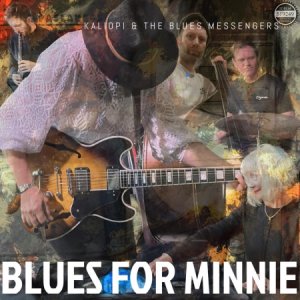 Kaliopi & The Blues Messengers – Blues For Minnie
Featured Interview – Anthony Geraci
|
“I didn’t come from a musical family. We didn’t even have a record player or a radio in our home. But, at four years of age I told my parents that I needed a piano. I really don’t remember what I heard that triggered that desire, but something in me told me I needed a piano to express what I wanted to express. Luckily, my mother listened and initially got me an old junk upright. At first, I would pick up little melodies I heard from church, and then a year later, my mother found me a piano teacher. I took lessons from him for a couple of years, and then started taking lessons at the Neighborhood School of Music that was affiliated with Yale University in New Haven, CT. They had a lot of teachers from Yale working there. Eventually my mother went out and bought me a Kimball baby grand piano that she paid $4 a week on.” While he was initially taught to play classical music, Anthony always found a way, beginning at a young age, to incorporate the blues into his playing, often to the annoyance of his teachers. “I always had this improvisational streak. If I was playing Bach, I would add extra notes—blues notes. I had this strict Russian teacher, and she would get five-year-old kids to play Rachmaninoff by memory note-for-note to try to embarrass me. But I was always drawn to the bluesy part of all songs. I was listening to The Doors do ‘Back Door Man’, and even though I dug all the tunes on their first album, I would be drawn to the bluesy part of their tracks. Blues just got into my soul, and luckily, I have been able to make a living at it.” Anthony’s direction turned fully toward the blues after an experience he had while still playing in rock bands in high school. “There was this guy named Ed Cherry in my school. Ed went on to be Dizzy Gillespie’s guitarist until Dizzy’s passing. His family was one of the only Black families at that time in our locale and he is a great guitar player. I used to go over to his house and listen to records, and one day he put on Chicago Bound by Jimmy Rogers. I literally hit the floor and asked if I could borrow it. I must have listened to it a hundred times before I brought it back. The ensemble playing is so beautiful on that record. It was just as poignant as any Bach invention, and the way they interweaved the guitars and harmonica with Otis Spann on piano was amazing. Bob Margolin once told me that Muddy and Jimmy would work out their parts ahead of time—it wasn’t improvised. They were very serious about their music. Years later I got to be on the road with Otis and learned directly from sitting at the piano with Sunnyland Slim, Lloyd Glenn, Roosevelt Sykes, and Pinetop Perkins. Pinetop would sometimes stay at my house for a few days. I had a Steinway upright in my kitchen, and while I’d be making him breakfast, he’d play. After breakfast we’d go into the living room where I had a beautiful Mason and Hamlin upright grand. Pinetop would just sit there and play all day. I never asked him to show me anything, but I observed and absorbed everything that he was doing. I feel very fortunate to have learned from those great blues pianists.”
“I first did two semesters at a community college in New Haven, but it was a very small music program, and I exhausted all their music credits in only two semesters. A friend of mine was going to Berklee, so I applied and was accepted. Once I got there I was immersed in all sorts of music: jazz composition, classical, writing, and orchestration. But I also enjoyed the non-music courses. Taking a class in the novels of Hermann Hesse was very cool, as was a Philosophy of Religion class where I handed in an old, crusted soy sauce bottle as my final paper…and got an A! I would stay in the piano cubicles every day from 7 am until 10:00 or 11:00 at night. Once when I was pounding on the piano there was a knock on my door. An Asian student asked me what I was playing and asked if there was a book he could buy to play ‘blues’. We chatted a bit and I told him to come back the next night. The next night he came to my practice room, and I gave him an Otis Spann cassette and a nip of Four Roses and told him to listen and play along with Spann. I also took outside lessons. There was this eclectic, kooky teacher named Harvey Diamond. I would go to his apartment on Commonwealth Avenue in Boston, and he would be in his robe. He was really big on ear training. What was interesting was you could adjust the turntables back then, so he would make it go sharp or flat so you would have to adjust your ear to sing the solos he wanted.” Anthony had more opportunities to play with blues legends when he joined the band, Sugar Ray and the Bluetones. “Ronnie Earl was with us at the time, and he had his little black book of musicians. We were the house band at a club in Cambridge called The Speakeasy and played every Sunday. Ronnie would call up people and they would come out and play with us. JB Hutto came out and Hubert Sumlin spent almost two months with us, literally being part of the band. He had Sunnyland Slim come out and brought Otis Rush out too. Those were great times!” Geraci credited Lightnin’ Hopkins and Ronnie Earl with being huge influences on his music. “I listen to Lightnin’ Hopkins all the time. I just think he’s brilliant and I love the storytelling he does. And Ronnie Earl is so soulful that it’s hard to describe. Many people have told me Ronnie’s first two records (Smokin and They Call Me Mr. Earl) were the reason they started to play blues music and I’m honored to have played on both of those recordings. When I played with Ronnie Earl and the Broadcasters there were no vocals—it was all instrumental. The music had to speak without lyrics and the instruments had to have their own voice. We would be doing three-hour shows without stopping and I learned a lot about being in the moment and feeding off other musicians in the band.” When asked how he learned about the business side of the music industry, Geraci noted that it came only from playing in bands since around 1966. “I learned about the business by trial and error because all I really cared about was playing piano. When I first started to pay with Ronnie Earl, he told me ‘Maybe you should buy a wallet,’ as I didn’t have one. I guess even back then the music was more important than the pay. I know Berklee has a business course now, but they didn’t have one back when I attended. I did learn a lot from Sugar Ray Norcia. He is such a calm, cool, collected guy.” Geraci has been a member of Sugar Ray and the Bluetones, Ronnie Earl and the Broadcasters, The Proven Ones, and he has led the Boston Blues All-Stars for the past 15 years. He has also been called upon to play with many legends when they had East Coast tours, including Chuck Berry, Bo Diddley, Otis Rush, and Big Joe Turner. He has also contributed to numerous albums by other artists, (such as Big Jack Johnson, Odetta, Kenny Neal, Big Walter Horton, Otis Grand), as he is one of the first pianists to be called when some of the finest artists make plans to record. He was asked how he so successfully transitions between being in a sideman role and then a bandleader role.
Geraci had a few great stories from working with legends such as John Lee Hooker and Big Mama Thornton. “I was playing with a blues band from New Hampshire (The John Wardwell Blues band) while I was still attending Berklee and there was a blues festival, and we were going to back up John Lee Hooker. Then we were going to back up Big Mama Thornton. I did my due diligence and got as familiar as I could with their music. The Hooker set went pretty well, but after one song, Big Mama Thornton threw everybody off the stage except for me. Then she went behind the drums and took out a harmonica and sang, played harmonica and drums. It was very early in my blues career, and she only had one harmonica, in F# I believe. I don’t usually care about keys, but back then playing everything in F# was somewhat difficult. But it was one of those experiences that helped me out and shaped me, like being thrown into the fire.” “Another occurrence that was pivotal in my career was opening up for the Muddy Waters Blues Band at Paul’s Mall in Boston. It was a week-long gig, and everyone that was into the blues came to see Muddy. That’s where I met Bob Margolin and Jerry Portnoy, who lived in the Boston locale. They invited me to weekly jam sessions when they weren’t on the road with Muddy. Two great pianists from the Boston area, Ron Levy and David Maxwell, would be at those jams and I learned a lot by just watching and listening to them. One night during the week-long gig with Muddy, an elderly woman came into the Green Room and said, ‘I’d like to speak to Mr. Waters.’ I happened to be sitting right next to Muddy Waters when she introduced herself. ‘My name is Annye Anderson and Robert Johnson was my stepbrother.’ The room went silent as she pulled a previously unknown picture of Robert Johnson out of her oversized pocketbook. ‘That’s him, that’s him!’ Muddy exclaimed, as he literally jumped out of his chair. We were all in shock. She has since written the book Brother Robert that is a very good read.” Geraci also had a few fun nights playing with the Blues Brothers. “I did one gig with Dan Aykroyd, John Goodman and Jim Belushi as a Blues Brother, and one with Dan Aykroyd when we played at a launch party for Aykroyd’s TV show, Soulman, Dan came dancing over to me while playing harmonica and quietly said, ‘I don’t really know what I’m doing, but let’s have some fun!’. It was nice to meet them. They were just regular guys having fun.” Geraci was asked how, unlike many artists, he managed to avoid the lure of alcohol and drug abuse. “I’ll be very honest. I did my share of drinking and drugs, but for some reason it didn’t take a hold of my soul. I started playing gigs in the mid-60s, so there were psychedelics around. And, in the 80s and 90s cocaine was everywhere. I feel very fortunate that I was able to keep an even keel and never let alcohol or any drugs take over my soul.” Geraci is also a teacher, and he has taught both academically and private lessons. He taught college classes in Vermont between 2003 and 2004, and at a Conservatory near Boston for a number of years.
Additionally, Geraci spent three years teaching for the Pinetop Perkins Foundation and is now a member of their Board of Directors. “I was really honored to be asked to be on the board. It is such a great thing. Every year we have the workshop and Bob Margolin is the Musical Director. I taught there for three years. It’s mostly young kids and these kids are really serious. They come and want to learn the blues. Kingfish (Christone Ingram) was part of it from an early age, and now, if he is around, he might come by and say hello, and play guitar for the kids because it’s held right in Clarksdale, Mississippi. Everybody on the board is so vested in keeping Pinetop’s legacy alive and it was his wish to have something like this, where young students can come and learn about the blues. It’s a wonderful thing. The Foundation also helps musician in need, similar to the aid offered by the HART Fund that is part of the Blues Foundation.” While discussing the Blues Music Awards, Anthony laughed when asked about the comparison that used to be made between him and Susan Lucci (the actress from All My Children who was nominated for an Emmy 19 times before finally winning the award). “It was the same with Sugary Rayford. I used to send a (photoshopped) picture to Sugaray every year after the BMAs of him, Susan Lucci and myself sitting at the table. But it is an honor to be recognized by The Blues Foundation and other organizations–I don’t take it lightly. I play my piano every day and I’m very serious about what I do. I’m proud that my band has been nominated three out of the last four years for Band of the Year.” Although Geraci is known for playing traditional blues, he also appreciates variations of the genre. “Blues rock is dominating the festival scene, but that’s ok. I love Walter Trout. He’s written the liner notes on my upcoming recording, Tears in My Eyes, and has played on two of my previous records. Mike Zito and Albert Castiglia have a long history in the blues circuit, and I love those guys. But I am also glad that some festivals have side stages for acoustic blues so people can hear some of the music that maybe doesn’t make it to the main stages. It’s great to hear artists such as Eric Bibb or Jontavious Willis play at major festivals. It gives people a bigger picture of blues music.” Geraci’s band, The Boston Blues All-Stars, plays all original music. He was asked which original song lyrics were the most meaningful to him, and he noted that a song does not require lyrics to be meaningful. “Sometimes words aren’t necessary. Early in 2019 we lost Mike Ledbetter (I was honored to play on the Welch/Ledbetter recording), my son Todd was hit by a truck with the result being his right leg being amputated above the knee, and our beloved dog Ella passed away. I know that sounds like a bad country song! The song, ‘Ode to Todd, Ella and Mike Ledbetter’ speaks without a word. Ronnie Earl and I co-wrote ‘A Prayer for Tomorrow’ on his most recent recording, and that speaks without words as well. However, if I had to pick one song for the lyrics, I would pick ‘Love Changes Everything’ from the Daydreams in Blue” album: Love changes everything I think almost all songs are love songs…Love does change everything-it’s why we breathe.”
“I am playing on a new recording that Johnny Rawls is producing for Patti Parks. Bob Corritore has been flying me down to Phoenix to play, and I’m playing on a soon-to-be-released John Primer album that Bob Corritore produced. Also, an album with Willie Buck and Oscar Wilson should be out this year. For my band’s album, Tears in my Eyes, we did a pretty long tour in Europe, and we had four days off in Prague, Czech Republic. I found this great studio in Prague. Paul McCartney’s band members had recorded there, and the sound engineer had recorded for the symphony orchestra. The studio owners owned the whole high-rise building, so we stayed above the studio in a little apartment. It was kind of fun and a bit funky—just the way I like it! We recorded for two days, and I used a beautiful Steinway piano. We recorded half of the album in Prague, and it came out great. The rest of it was recorded at a local studio in Boston. Paul Loranger is my bass player, Barrett Anderson is on guitar, and my drummer is Kurt Kalker. Paul and Kurt played with the late, great Candye Kane for many years. Anne Harris played violin on one song, and I have Sugar Ray Norcia doing a couple of vocals and Barrett sings on the title track. One song is called ‘Memphis Mist’. I got the inspiration for it walking down near the Mississippi River in Memphis at 6 or 7 am and there was this beautiful hypnotic mist over the river—almost embracing and engulfing you, but not giving up any secrets. Anne plays on that song and her playing is beautiful.” Geraci was asked if there were any young blues artists, other than Kingfish, that he found exciting. “Ben Levin is amazing. He’s a really great piano player. He was a student at the Pinetop Perkins Foundation, and then he became an intern. Dylan Triplett is also good, although he is more on the soul and R&B side. I dig Eddie 9V—he just came out of nowhere and he is really good.” When asked whether there was anything he wished people would better understand about the blues, Geraci pointed out the ways in which people currently miss out as opposed to the manner in which fans used to await the release of albums in past decades. “I think there is a big difference in how people listen to music now. I remember taking the bus to New Haven to buy Wheels of Fire by Cream the day it came out. It was important! Now all you need is two thumbs and you can get anything you want. People my age would sit down and listen to a whole record. People don’t listen to a whole record anymore. They just listen to one or two songs. We used to love sitting down and listening to a new record with friends. I think everybody is too much in a hurry these days and that’s too bad.” When asked if there was anything else he would like the public to know about him, Geraci simply said, “Well, I haven’t been in a barber’s chair since 1967.” If avoiding the barber’s chair had any connection to Anthony Geraci’s tremendous talent, we would all try canceling our future haircuts. You can learn more about this amazing artist, including the release of his new album, Tears in My Eyes, at www.anthonygeraciblue.com Writer Anita Schlank lives in Virginia, and is on the Board of Directors for the River City Blues Society. She has been a fan of the blues since the 1980s. She and Tab Benoit co-authored the book “Blues Therapy,” with all proceeds from sales going to the HART Fund. |
 Pianist, Hammond B-3 organist, and composer Anthony Geraci has been a humble and low-profile, but hugely significant contributor to the blues community for approximately forty years. He has been a member of several bands (including one he leads), is a prolific songwriter, has served as a sideman to many of the legends, and has been a guest artist on almost too many albums to count. His musicianship is well-respected, although he was jokingly referred to as the Susan Lucci of the Blues Music Awards due to many consecutive years of being nominated for an award without winning. His work was then fully recognized when he won the Instrumentalist-Piano/Pinetop Perkins Piano Player of the Year Award in 2021, (and then won it again in 2023). He has had 17 Blues Music Award nominations, including a nomination for best Traditional Male Blues Musician, his band was nominated three times as Band of the Year, and his album (Fifty Shades of Blue), was nominated for Traditional Blues Album of the Year (and the title track was nominated for Song of the Year). Fifty Shades of Blue was also ranked as one of the top blues recordings of the year by Living Blues Magazine and Anthony contributed to an album (Super Harps) that earned a grammy nomination. When you hear the level of his skill you will not be surprised to learn that he began playing piano at age four and still practices every day.
 After high school, Geraci attended the Berklee School of Music, obtaining a bachelor’s degree in music, and later completing a master’s degree in music from Skidmore College.
 “It is just about respect for the people you’re playing with, and you have to know your place. I think that is what most musicians need to know, whether they are a sideman or a leader. Even when I’m the leader, I tend to give the guitar player more solos than I take. I prefer songs over jams. I find that when I’m in a sideman role I listen to who I am playing with, and it takes years and years of experience to do that well. When I first started playing with the Chicago guys, like Hubert Sumlin and Otis Rush, I would put on stacks of records to prepare because I never wanted to get stumped on stage or get the ‘stink eye’. I think it comes down to respect for the music and respect for the musicians you are playing with.”
 “I taught History of the Blues, History of Rock & Roll, and World Music. That was interesting. Teaching is harder than people think. You have to keep your students engaged and it took me awhile to get it together. I learned as much as my students, especially when I crossed over and had to teach world music. That was interesting—it opened my mind to some great music. Interesting fact—there’s not a society in the world from as far back as we know where music wasn’t an integral part of life. Some of the earliest artifacts found are flute-type instruments made from deer antlers or animal bone. I would have loved to be in a Neanderthal jam session!”
 Geraci continues to be a guest on many other artists’ albums. And, his most recent project is an album called Tears in my Eyes, which is due to be released April 19 on Blue Heart Records. It was recorded half in Prague, Czech Republic and half in the Boston locale.
Featured Blues Review – 4 of 4
|
Independent Release 10 Tracks – 50 minutes Very little information is available about Mark Easton on either his web site or with notes he provided with his album release. What I discern from the provided information is that Mark is from Australia. He has a long history in music with steps in punk rock, the glam scene, and more recently settling into blues. His early career found him on the stage with bands such as Cult, Cheap Trick, AC/DC, and Skid Row among others. Certainly not bands that we would think would have any connections to the blues. He traveled throughout Asia in 2018 and 2019 and came back with new concepts for his music utilizing some exotic instruments he discovered on his trip. Mark is listed as playing, guitar, bass, drums, darbuka, morin khuur, dombra, jaw harp and vocals, including throat singing. If you are like me some of those instruments are unknown. So, let’s define them so we understand what we hear. A darbuka is a goblet-shaped drum, also known as a doumbeck or tabla and used extensively in Middle Easten music, particularly in belly dancing. The morin khuur is a traditional Mongolian bowed string instrument also known as a horse-headed fiddle. It has only two strings attached across a bridge generally tuned to B-flat and F. The dombra, sometimes also knows as a tambura, is another two-stringed instrument commonly used in central Asian cultures and most commonly used in Kazakhstan. The strings are strung down a long skinny neck and a pear-shaped body, flat on the front and rounded at the back. Lastly throat singing is a Mongolian form of vocals forming sounds in the mouth, jaw and throat at the same time. Kim Brown is added on bass and Tony Cardinal on drums with special guest Marji Curran providing vocals on one song. The album was released in November and went to #4 on the Australian Blues and Root charts in December. The songs are all covers of classic blues artist’s songs. The album opens with Floyd Jones “On the Road Again” from 1928, which was also performed by Tommy Johnson and later by Canned Heat in a more current and well-known version. It opens with horses neighing and features some of the instruments mentioned above, apparently the morin Khuur and utilizing throat singing for the chorus. Howlin’ Wolf’s 1956 song “Smokestack Lightning” is next with the middle Eastern instruments used in the lead with Mark utilizing a deep voiced growl to emulate the Wolf. Two Willie Dixon songs follow. 1965’s “Taildragger” opens with the sound of a howling wolf, which I assume is a tribute to the Wolf, who also recorded the song. 1962’s “You Need Love”, originally recorded by Earl Hooker in 1962, continues the use of the non-traditional instruments mixed to a traditional vocal with Marji Curran adding the backing vocal. Joe Williams 1935 song “Baby, Please Don’t Go” continues the path of the earlier songs with Mark’s growling vocals accompanied by the unique sound of the instruments. Two More Willie Dixon songs are up next. 1954’s “Hoochie Coochie Man” was again first recorded by Howlin’ Wolf as was 1960’s “Wang Dang Doodle”. Mark mixes some Eastern sounding vocals into the more conventional blues vocals. John Lee Hooker’s 1948 “Crawling Kingsnake” continues Mar’s approach to the songs. “Spoonful” written by Willie Dixon and again first recorded by Howlin’ Wolf in 1960 jumps as powerfully as the original version. “This Train”, also known as “This Train Is Bound for Glory” is a traditional gospel song first recorded in 1922 and later was a hit for Sister Rosetta Tharpe in 1930. Mark’s gruff vocals certainly fits the classic feel of the songs he is interpreting. But as stated with the album’s title, nothing’s sacred about his approach to the music. There are times that the instrumentation reminds me of Clarence “Gatemouth” Brown’s use of the fiddle in his approach to the blues. If you are expecting the songs to follow along in a traditional path, then this album will probably not meet your expectations. The unique approach to the music will demand your acceptance of a sound way outside of anything released from Chicago. It is interesting and it is the blues, but it is not the blues as we commonly recognize them. Reviewer John Sacksteder is a retired civil engineer in Louisville, Kentucky who has a lifelong love of music, particularly the blues. He is currently the Editor of the Kentuckiana Blues Society’s monthly newsletter. |
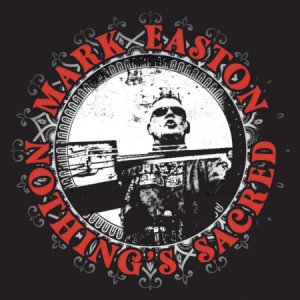 Mark Easton – Nothing’s Sacred

© 2024 Blues Blast Magazine 116 Espenscheid Court, Creve Coeur, IL 61610 (309) 267-4425
